The Löffelholz Codex: The Tool Book of a Nuremberg Knight
The Nuremberg house book of Martin Löffelholz (from 1505), page by page: facsimile, transcription, reading and interpretation. A non-commercial project.
The Nuremberg house book of Martin Löffelholz (from 1505), page by page: facsimile, transcription, reading and interpretation. A non-commercial project.
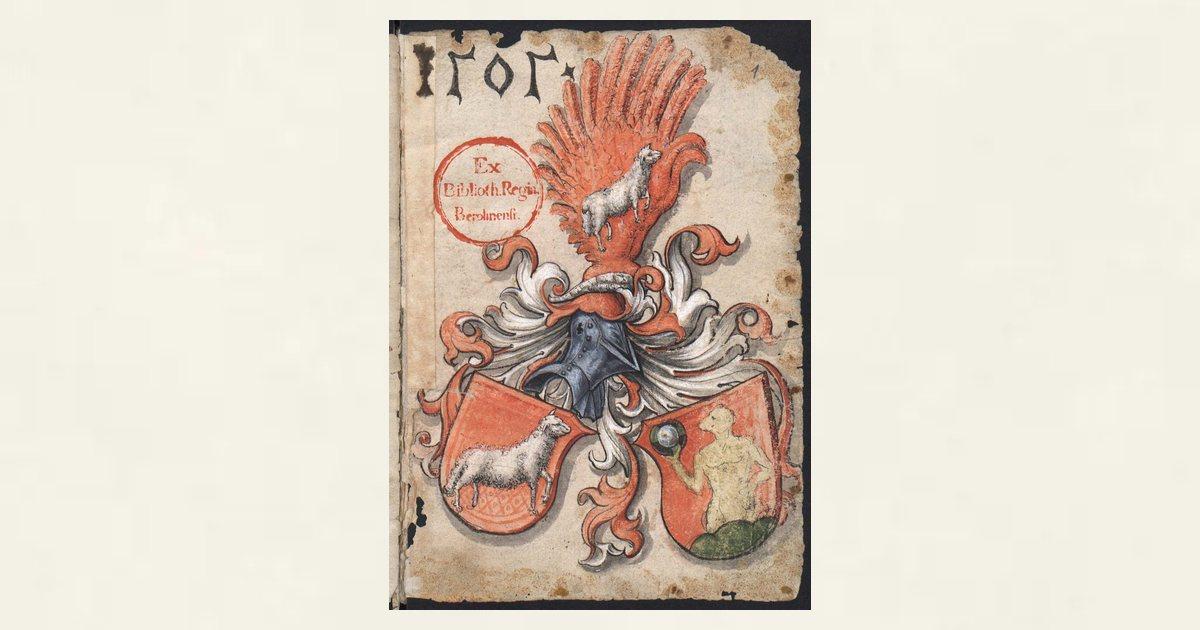
More than 500 years ago, around 1505, a Nuremberg patrician and knight named Martin Löffelholz started a book. He wrote it by hand and filled it with beautiful technical drawings. He drew things he knew and used: a drill with interchangeable bits, a workbench with a vise, all kinds of weapons. But also some rather unusual things: a rotating spiral staircase, a cradle with mercury in its rockers ... and even an "office chair" on casters.
The original manuscript is kept at the Jagiellonian Library in Kraków, Poland. It has been digitized and is in the public domain.
I first got my hands on the scans in 2022 and knew I wanted to do something with them. Individual pages have been discussed in the literature, but I couldn't find a complete transcription of the book. So I decided to work through it myself, one page at a time.
I'm publishing my work as I go, gathering feedback from experts, and using what I learn to revise the pages. I hope that, over time, this will become a complete transcription and interpretation of the manuscript. Freely accessible to anyone who finds this 500-year-old book as fascinating as I do.
The Codex has 154 pages. 128 have been reviewed, 26 to go.
To make sense of all 154 pages, I give every folio a page of its own on this website. It contains:
I used AI to help me read the handwriting, suggest transcriptions and interpretations, and find relevant literature.
Then I work through each page individually. I examine the drawing, read what others have published about it, and carefully review the AI's transcription and interpretation. My main goal is to understand what Löffelholz drew and how it might have worked. My background in engineering helps, as does my curiosity. I also look for working replicas and surviving objects from the period.
Based on this research, I rewrite each page to explain the drawing and its mechanism step by step. If something remains unclear, or I cannot figure out how a mechanism worked, I say so openly.
A few pages are still marked "raw transcription". These contain the AI's initial drafts. I have read through them, but have not yet checked every detail. I keep them online so others can follow my research and contribute their own insights. However, I ask search engines not to index these pages.
Uncertain readings are highlighted in color. Gaps remain gaps. And interpretations are just that: possible explanations, not established facts.
I write this website in German first. The English version is my own translation, with help from AI. English is not my first language, so if you come across anything that sounds unnatural or unclear, please let me know.

I am Dirk Schornstein, an engineer (Diplom-Ingenieur), and I have been building websites for 30 years. This project matters to me, and there is no money in it. AI takes some of the groundwork off my hands. But I would not publish any of this without a human mind like my own and the knowledge of specialists. You need people who understand mechanics. People who can really read the script, or who know how a crossbow is built. That expertise is what I try to take in and work into the pages. Many have joined in: reading the handwriting with me, or letting me use pictures of replicas they had built years before. The pages grow with everything we learn. Who has helped so far →
I'd love to hear from anyone who shares my curiosity about Löffelholz's work. You don't have to be an expert to contribute. I'm especially interested in hearing from people who:
Every contribution helps, whether it's a corrected word, a technical explanation, a photograph, or a completely different interpretation.
If you help research a page, I'll credit you on it. And please don't hesitate to question my conclusions. Corrections and constructive criticism are just as welcome as new discoveries.
Once a month I take a page I do not understand, put it up here, and ask who can help.
Open · Löffelholz Mystery November 2026
Four texts, three eggs and a ring. Which four tricks does Löffelholz describe on this page?
A house book from Nuremberg, begun in 1505 by Martin Löffelholz von Kolberg. Its 154 pages show tools, machines, locks, weapons, hunting gear and recipes, drawn by hand with short captions. The original is in the Biblioteka Jagiellońska in Kraków. The Codex is described in full on loeffelholz-codex.org under "What Is the Codex?"
Early New High German, in the written form used in Nuremberg. It is German, but the German of 1505, and spelling was not fixed yet. The same word can appear two ways on one page, a stroke over a letter stands in for an n or an m, and the words from the workshop are in no modern dictionary. There are examples from the manuscript on loeffelholz-codex.org under "What Is the Codex?"
In the Biblioteka Jagiellońska in Kraków, shelfmark Ms. Berol. germ. quart. 132. The whole manuscript has been digitized and is free to look at in the Jagiellonian Library's digital collection at jbc.bj.uj.edu.pl. Where the book came from and how it got to Kraków is set out on loeffelholz-codex.org in the Fact Sheet
None that has been published, as far as I know. There is literature on single leaves and a long video discussion, but no edition that reads and explains all 154 pages. That is what has been going up on loeffelholz-codex.org since 2026, page by page: facsimile, transcription in the original spelling, a reading in modern German and English, and a suggested interpretation. Every page states how far it has been reviewed.
A Nuremberg patrician and knight, died 1533, and the man who wrote the Löffelholz Codex. He was warden (Pfleger) of the fortress of Lichtenau for 28 years. Between 1507 and 1509 he was held prisoner for more than a year, and shackles and locks take up a lot of room in his book. His life is told on loeffelholz-codex.org under "About Martin Löffelholz"
I hope you find something here that surprises you the way it surprised me: a drill with an interchangeable chuck, a swivel chair on casters, a tinder lighter, a carabiner.
Texto de loeffelholz-codex.org tal como lo publicó, leído de su página y mostrado aquí con el formato de El Autómata. El original, en loeffelholz-codex.org · Volver a la noticia de El Autómata