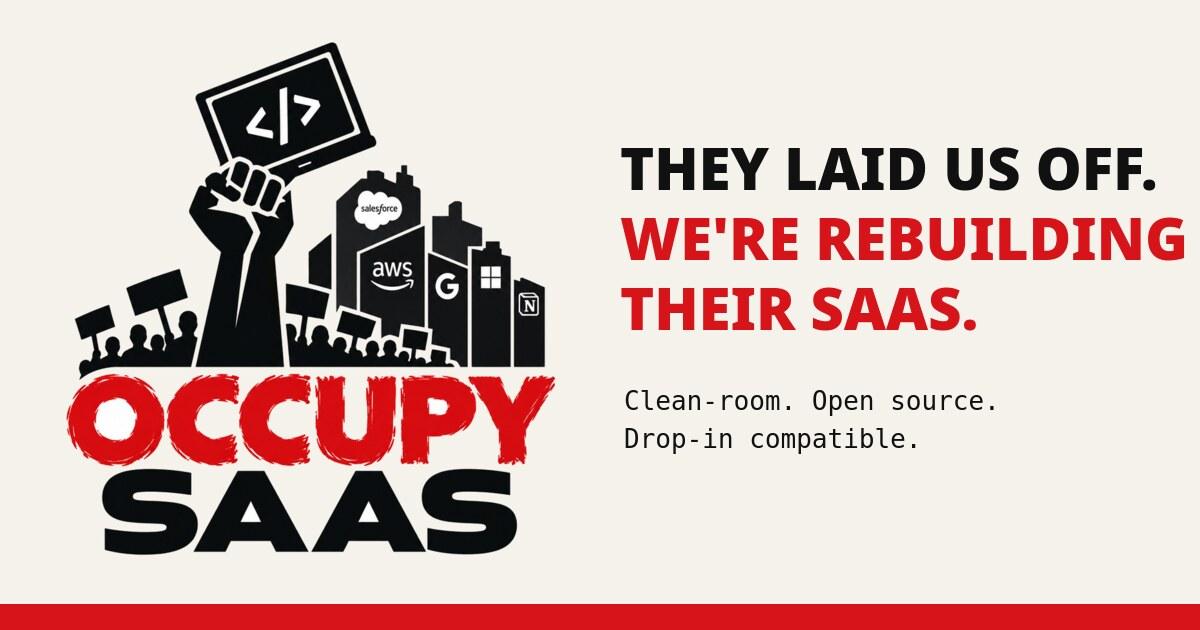
OccupySaaS — They laid us off. We're rebuilding their SaaS.
Clean-room, AI-assisted, open-source, drop-in replacements for the SaaS giants. Apache-2.0. Self-hosted. No per-seat tax.
Clean-room, AI-assisted, open-source, drop-in replacements for the SaaS giants. Apache-2.0. Self-hosted. No per-seat tax.
Est. October 2026 · Apache-2.0
OccupySaaS is a protest movement written in code. Laid-off engineers, armed with AI and public documentation, are building clean-room, open-source, drop-in replacements for the platforms that rent our own industry back to us — one seat at a time.
New: ZeroAuthy v1.0.0-rc.1 is out
We are the
1,000,000
The grievances
In 2011, Occupy Wall Street asked who the economy was really working for. In 2026 we're asking the same question about the cloud. The tools every company runs on are now toll booths — and the people who built them were shown the door.
Per-seat pricing is a tax on growth
Every hire, every intern, every contractor — another line item. Infrastructure shouldn't charge rent by the head.
Lock-in is not a feature
Proprietary APIs, export walls and surprise price hikes keep customers captive. Compatible open alternatives set them free.
They cut us. We commit.
A million engineers were let go while the platforms kept growing. We still know how to ship. Now we ship it in the open.
The method
We don't leak, decompile or copy anyone's code. Every project is rebuilt from public documentation and open standards, with AI doing the heavy lifting on the build side of a strict firewall — then proven compatible against the vendors' own public SDKs.
Public API references, open standards (OAuth 2.0, OIDC, REST) and published SDK behaviour become a written specification. Nothing confidential, nothing leaked, nothing from former employers.
Spec writers and builders stay separated. Each repo carries a CLEAN_ROOM.md policy, and provenance is recorded for every fixture and reference.
AI agents implement from the spec alone — contracts first (openapi.yaml), then code, then tests — under human review at every merge.
A compatibility laboratory runs the vendors' own public client SDKs against our server. If your existing code doesn't work unchanged, it isn't done.
Apache-2.0. Self-hostable. Pluggable storage. No telemetry you didn't ask for, and no seat counter.
Clean room
First releases
Identity and CRM: the two subscriptions almost every company pays for and almost nobody loves. ZeroAuthy has shipped its first release candidate, SalesCompel is still early, and both welcome contributors today.
Release candidate · v1.0.0-rc.1 Go
Replaces
Auth0A self-hostable identity server that speaks the Auth0 APIs. Point an existing Auth0 SDK at a ZeroAuthy tenant domain and log in. The first release candidate is an early preview that covers what most Auth0 tenants use.
Not in this release: WebAuthn, passkeys, SAML, WS-Federation, enterprise directories, CIBA, JAR and token exchange. Full compatibility notes
# try the release candidate (self-signed TLS, for testing only)
$ docker run -d --name zeroauthy -p 8443:8443 \
  -v zeroauthy-data:/data \
  -e ZEROAUTHY_SERVER__LISTEN=:8443 \
  -e ZEROAUTHY_SERVER__SYSTEM_HOST=localhost:8443 \
  -e ZEROAUTHY_SERVER__TLS_SELF_SIGNED=true \
  -e ZEROAUTHY_SERVER__TLS_SELF_SIGNED_CA_FILE=/data/ca.pem \
  -e ZEROAUTHY_SECURITY__MASTER_KEY="$(openssl rand -base64 32)" \
  -e ZEROAUTHY_BOOTSTRAP__ADMIN_EMAIL=you@example.com \
  ghcr.io/occupysaas/zeroauthy:1.0.0-rc.1
SQLitePostgreSQLMySQLgRPC pluginsApache-2.0
Early · in the open Go · Vue · TypeScript
Replaces
SalesforceA free, open-source Salesforce replacement with a tenant-isolated Go/PostgreSQL core, a Vue record editor, and a compatibility laboratory that checks behaviour against Salesforce's public API contract.
describe and limited queries# run the compatibility laboratory $ npm ci --prefix compat/clients/node --ignore-scripts $ npm --prefix compat/clients/node run check
PostgreSQLMulti-tenantRESTi18nApache-2.0
Our motto
Your code, your data, your servers. No seats to count, no renewals to dread, and nobody who can switch it off but you.
The occupation map
Every category on this board is a monthly invoice somewhere. The movement picks the next target in public — bring a spec, a use case, or a grudge.
● Occupied
ZeroAuthy — Auth0-compatible login, tokens and tenants.
● Occupied
SalesCompel — Salesforce-compatible records and REST API.
○ Proposed
Team knowledge bases that don't lock your writing behind a seat licence.
○ Proposed
Tickets, sprints and boards with a compatible API for existing integrations.
○ Proposed
SDK-compatible flag evaluation you can run next to your own services.
○ Proposed
Logs, metrics and traces without per-gigabyte ransom notes.
○ Proposed
Help desk, inbox and knowledge base, priced at zero agents.
+ Your pickOpen an issue and make the case.
Proposed categories are open for discussion, not commitments. Names of existing products are used only to describe compatibility.
Lineage
Occupy Wall Street began on 17 September 2011 in Zuccotti Park, New York City, with a simple frame: the 1% and the 99%. It had no leaders, made decisions in open assemblies, and spread to hundreds of cities.
OccupySaaS borrows that spirit and swaps tents for terminals. No marches, no property damage — just working software, published under an open licence, that anyone can run.
“We are the 99%.”
Protesters set up camp in Zuccotti Park in Manhattan's Financial District.
Occupy camps and general assemblies appear in cities around the world.
The camp ends; the language of the 1% and the 99% doesn't.
Wave after wave of cuts across the industry while subscription prices keep climbing.
The first clean-room rebuild opens its repo under Apache-2.0.
The second tower. More to come — decided in the open.
The first release candidate: binaries and a container image anyone can run today.
Join
You don't need permission, a badge or a manager. You need a laptop and an afternoon.
Pick an open issue, follow the clean-room policy, open a pull request.
Run a release against your real SDKs and tell us exactly where it breaks.
Turn public docs into precise, testable specifications for the builders.
Star the repos, share the site, and tell your CFO what you're paying per seat.
Fund the occupation
The occupation runs on laid-off engineers. Donations support the collective doing the work. Give a little or give a lot — on whichever platform you trust.
Small & quickThe easiest way to drop a few dollars. Best for small one-off tips; it takes the biggest cut of what you give.
Buy us a coffee FundraiserOur main fundraiser for the laid-off tech worker collective. A good home for larger donations.
Give on GoFundMe FundraiserThe same fundraiser on a different platform, for anyone who would rather not use GoFundMe.
Give on GiveSendGoWhy two fundraisers? Some people won't use one platform or the other. We'd rather take your support wherever you're comfortable giving it.
Questions
Clean-room reimplementation is a long-established way to build compatible software: you work only from public information and independently write your own code. Interoperating with an API is not the same as copying a product. Each project publishes its clean-room policy and source provenance so anyone can check the work. This page isn't legal advice; if you're adopting a project for a business, talk to your own counsel.
Are you affiliated with Auth0, Okta or Salesforce?No. OccupySaaS and its projects are independent and not affiliated with, endorsed by, or sponsored by any vendor named on this site. Product names are used only to describe compatibility.
Can former employees of those companies contribute?Yes, but never with confidential knowledge from a former employer. Contributors work only from public
material, and anyone with relevant inside knowledge should stay on the public-spec side of the firewall
or sit that project out. When in doubt, read the project's CLEAN_ROOM.md and ask first.
Because the giants had thousands of engineers and we have a movement. AI agents let a small group turn a precise spec into working code quickly. Humans write the specs, review every change, and own the result, and compatibility tests against real SDKs decide what counts as done.
Why Go?Portability. A Go project compiles to a single self-contained binary, so self-hosting means dropping one file onto a server or into a Docker or Podman image — no installer, no runtime to set up, no tree of shared libraries to keep in sync. The same toolchain cross-compiles for Linux, macOS, Windows, x86 and ARM, and the result fits in a minimal container image. If you're leaving a SaaS vendor, the replacement should be this easy to carry.
Why not Rust?Nothing is wrong with Rust, and we're not against it. Go was picked for the first projects because it makes the one-file, container-friendly drop-in the default with very little build setup. Rust can get there too; Go just gets there more simply for the kind of servers we're building.
Rust recreations of these projects are welcome — they just haven't been made yet. The specs, API contracts and compatibility tests are language-neutral, so a Rust port can be checked against the same SDKs. If you want to start one, open an issue and say which project.
Is it production-ready?Not yet. ZeroAuthy's first release candidate, v1.0.0-rc.1, is an early preview, and its compatibility matrix lists the gaps. SalesCompel is earlier still, and its README says exactly which features work today. Try them, break them, and file issues.
What does it cost?Nothing. Every project is released under the Apache License 2.0. Run it, fork it, sell services around it. The only thing we ask is that you contribute back what you can.
Texto de occupysaas.com tal como lo publicó, leído de su página y mostrado aquí con el formato de El Autómata. El original, en occupysaas.com · Volver a la noticia de El Autómata