The rise and fall of Jev hype
What can we learn about the hype engine that declared war on rational and critical thinking?
What can we learn about the hype engine that declared war on rational and critical thinking?

This is a quick note on how the industry’s reaction to Jev reveals the desperate state of AI. I’ll dissect:
The point is to use Jev’s hype cycle to call out the manipulative marketing that are too familiar with at this point.

You probably don’t need an intro to Jev at this time because since its introduction 33 days ago, it has been all the rage!
But if you were clever enough to ignore it, here’s what actually matters:
Jev is basically a general purpose classifier (e.g. quick judgement). What makes it interesting is that you don’t have to train it with a lot of data (although that lack of special-purpose training negatively impacts its utility).
Calling it a “decision model” is a bit far fetched especially since it cannot even see (rival open-weight models have multi-modal features) or reason (that’s how it’s so cheap).
The idea behind Jev isn’t new! The idea of non-autoregressive decision models with RL goes back more than a year ago. The original author is pissed but as we’ll see drama is an inseparable part of AI hype.
I want to walk you through the emotional roller-coaster I went through when I read their announcement via hackernews:
😎 So the founder was behind ChatGPT, one of the fastest-growing products in history. I’m listening…
😃 Oh, my god! This is it! ChatGPT is missing something big and he’s about to reveal it! We’re one step closer to AGI if we haven’t reached it already! I’m thrilled to read more…
😱 Spit it out! I’m beyond excited to read this…
😯 Wait what?!! “System one”?
Do you understand what you’re talking about? Here’s my recollection of how Daniel Kahneman defined the two systems:
If Jev is system one then LM is system two? It can’t even handle logical reasoning!
Most importantly Jev came with another interesting framing:
can’t hallucinate
Hallucination is one of the biggest problems with the current generation of language models but no hallucination doesn’t mean the response is logically correct. In Jev’s context, it just means that the output matches the schema.
Technically conventional language models can gain this ability by bolting a control loop (e.g., type checker, JSON schema parser) on top. Jev does this much faster and without reasoning. It’s in the name:
I don’t know Jev’s architecture because in the true ex-"Open”AI employee tradition, not much is released (probably in the name of “safety” or “moat”). But that doesn’t stop them from dropping jargons:
Note: RLCD rhymes with the “traditional” methods:
They even claim:
Fortunately, there’s no shortage of similar models, some of them with even better performance:
So let me sum up the marketing strategy:
OK, I think at this point we’ve seen this pattern enough to recognize it. I actually think Jev’s team kicked it up a notch to a comical level. Whether their marketing is written by LLM or not, they nailed it.
Fortunately, Jev’s initial noise died off almost at the same speed that it blew up. I can only speculate that as more people experimented with it, we realized:
Jev is not completely hype, we just went from “Peak of Inflated Expectations” to the “Trough of Disillusionment” in record time:
It’s not dead. Some companies use it while I believe the majority of use cases are addressed by open-weight rivals.
I really don’t want to bash Jev. Instead I want to use it as an example of where we are, as an industry.
I was one of the lucky few who got access to GPT-2 when it was invitation-only.
As a senior tech lead, I allocate part of my time to scout new tech and experiment in order to stay relevant. Prior to that, I had experienced IBM Watson and a bunch of other products so it wasn’t a big deal for me personally.
I was actually underwhelmed by GPT-2 because at the time it could:
Summarize text
Then I saw someone create a turn-based dialogue from one of these models and to spice it up, they added an avatar to it. I thought it was creepy and funny.
Then Blake Lemoine came out claiming Google’s language model named LaMDA was conscious. Unsurprisingly, this started a philosophical discussion that’s still ongoing on the side. Again, I didn’t give it too much thought.
BUT, Sam Altman, having spent a few years at the startup accelerator (Y Combinator), saw an opportunity. Specifically the chat application seems to have got his attention and soon ChatGPT was announced.
At the time, I thought it was a cool way to turn their token prediction model into a user-friendly product for the masses.
Personally, I couldn’t use it seriously because:
I vividly remember the backlash Google got for their multi-modal demo when people realized it wasn’t recorded in real-time! Those were the days when even a small deception would be a conspiracy.
When llama.cpp came out I got a gaming machine with an NVIDIA card (AI machines weren’t a thing back then) to build with AI.
Meanwhile people discovered that language models can generate code It was tedious to copy/paste it so we got the early versions of a harness.
Quickly after, we got “function calls” which allowed the models to do stuff!
I was using VS Code at the time and the hype was hard to ignore even though my company at the time had a strict policy against using AI tools (yes! hard to believe that just 3-4 years ago companies prioritized IP over velocity).
I remember paying for a Copilot subscription out of pocket and using VS Code insider on my open source projects.
I was so frustrated that I shared this meme on the company Slack:

Meanwhile there was drama at OpenAI (Ilya was part of a coup that fired their CEO, then Satya was playing 4D chess while Elon was lawyering up). It was a sh*tshow which is exactly how it managed to capture the interest of non-techies, a trend that continues to today with “almighty rogue AI” hacking others while whistle-blowers and alarmists rise speak of existential threat!
Simultaneously premature AI products were creating dramas of their own (assisting crimes, cheating, etc.) and AI bros anthropomorphize the tool as if it had desires of its own (my read: they want to judge accountability).
There’s also circular investment, pentagon drama, chip wars, autonomous killer drones, etc. but in the spirit of brevity, let’s stick to the technical side of things.
Then Peter Steinberger, a veteran developer who was away from computers due to burnout, created an AI companion, which brought the Agents (LM that can do stuff) to the mainstream.
So far I’ve covered:
Instruction-tuned models
Function calls
Coding harnesses
AI agents
Let’s speed through the other incremental improvements:
This is good progress, no question about it. But I think a part of the reason AI is a hot topic is all the drama surrounding it:
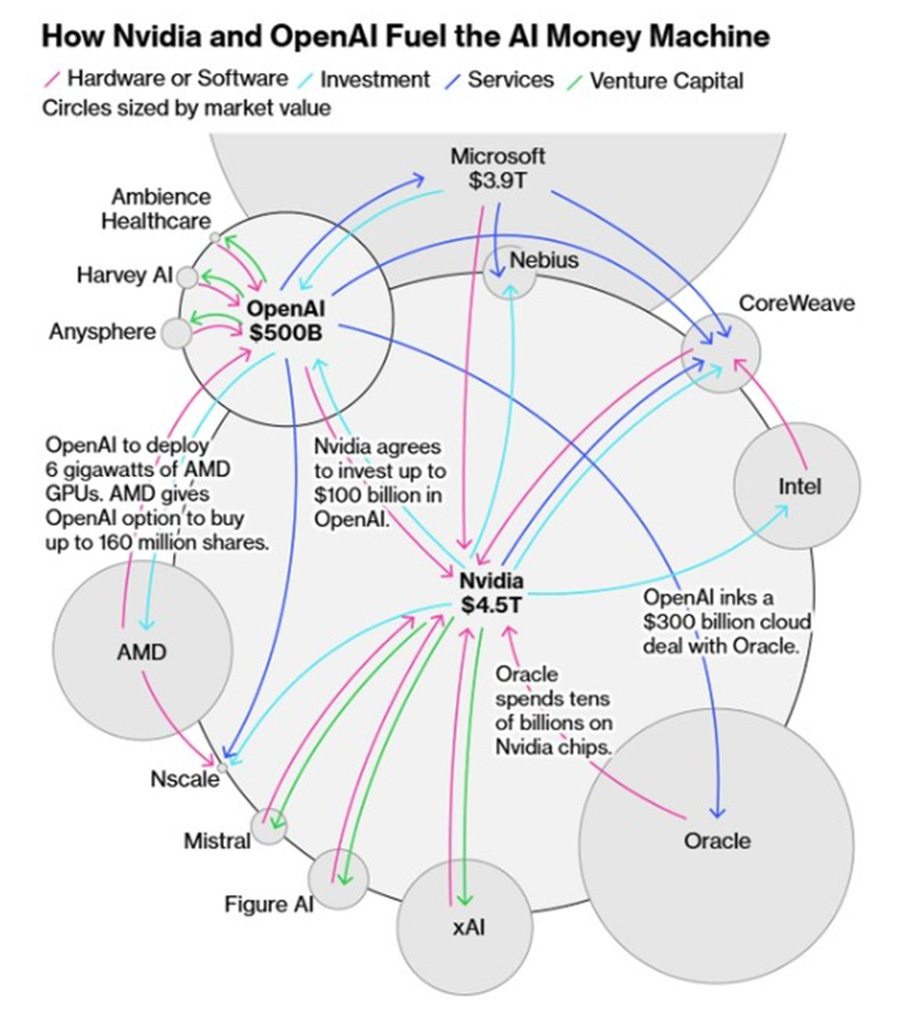
AI is hot, because it can potentially impact all of us. But we have to remember one simple fact:
Most notoriously, we have difficulty understanding the S-curve (meaning the pace of change is slow at the beginning and end).
And with prominent scientists leaving their lucrative positions to slow down the pace of development, we really cannot be sure about how long it will take for AI to really manifest the changes, if ever.
With all the incremental improvements of the past few years, we still haven’t solved some fundamental problems.
Here’s a short list of what I consider truly game changing:
All of this, is not to say that AI won’t be used to:
Robosoldiers and robocops
Generate new diseases
etc.
The truth is: you don’t need AGI-level of intelligence to cause destruction. The current generation of AI, paired with harness, tools and skills is plenty capable of causing damage in the wrong hands.
And if you think this is not happening already, I know a guy who gives free ice cream in his basement! 🙃
I think Jev is a good example of how great marketing fizzed out in the face of reality.
Is it useful? Yes.
Is it relevant? Yes.
Is it dead? Just its hype.
If I had a magic wand, I would want us all to step back and see the holistic arc of recent events and calm down a little. The red flags are easy to see:
Unfortunately, I think that ship might have already sailed and in the age of mass-produced synthetic content and personalized propaganda, maybe we’re too stressed to think straight.
Maybe LLMs are “system two”, after all, if we collectively lose our critical thinking and let our emotions be manipulated with the kind of marketing and manipulation we’ve seen too much lately.
Someone shared this on Hackernews (thank you 🙌) and it went all the way up to 2nd spot.
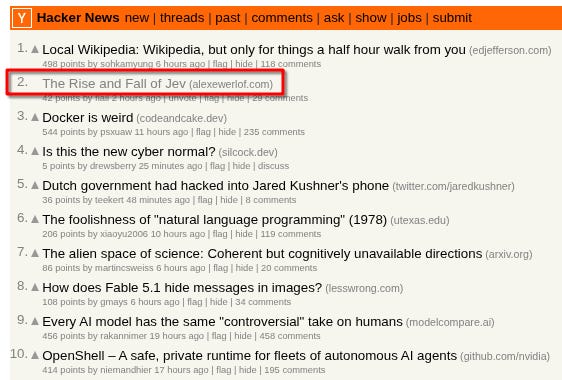
The early comments came at agentic speed and were unanimously focused on two things: 1) anecdotes about Jev being alive, and conveniently ignoring competition, 2) taking it personal and making it personal as if killing the messenger will make the message false. Weird. 🤔
If you found this piece insightful, please share it in your circles and on social media to inspire others.
My monetization strategy is to give away most content for free but these posts take anywhere from a few hours to a few days to draft, edit, research, illustrate, and publish. I pull these hours from my private time, vacation days and weekends. The simplest way to support this work is to like, subscribe and share it. If you really want to support me in lifting our community, you can consider a paid subscription. If you want to save, you can get 20% off via this link. As a token of appreciation, subscribers get full access to the Pro-Tips sections and my online book Reliability Engineering Mindset. Your contribution also funds my open-source products like Service Level Calculator. You can also invite your friends to gain free access or save via a group subscription.
And to those of you who already support me, thank you for sponsoring this content for the others. 🙌 If you have questions or feedback, or you want me to dig deeper into something, please let me know in the comments.
Texto de blog.alexewerlof.com tal como lo publicó, leído de su página y mostrado aquí con el formato de El Autómata. El original, en blog.alexewerlof.com · Volver a la noticia de El Autómata