Todos los periódicos y la radio, en unoEscrito por IA a partir de Hacker News · Cómo se hace
Hacker News
Número 12
12-05-2026
Peter Detlef Anton Rossbach, José de Anda-Sánchez, Jörg Karl Janisch and Julius-Fabian Müller
SANITATION: THE GREAT PENDING MATTER
According to the National Water Commission (CONAGUA, 2024), only 40 percent of wastewater receives some type of treatment in Mexico: approximately half of the municipal flow and about a quarter of the non-municipal flow (including industry) (figure 1). The remaining 60 percent—equivalent to more than 306 000 liters per second, that is, 26 billion liters per day—is discharged directly into rivers, lakes, and aquifers, with serious consequences for public health and ecosystems.
Figure 1. Wastewater in Mexico: composition by origin and treatment (2022)
Municipal: 281.9 m3/s Non-municipal (including industry): 226.2 m3/s
CONAGUA
This panorama reflects a global challenge. Follow up of the Sustainable Development Goal (SDG) 6.3.1, which measures the proportion of domestic and industrial wastewater treated appropriately, estimates that in 2022, around 58 percent of domestic wastewater globally was safely treated (UN-Habitat & WHO, 2024). In the case of industrial wastewater, the numbers are unclear; however, widely disseminated estimates since 2017 indicate that more than 80 percent of the world’s wastewater (domestic, industrial, and from other origins) is discharged into the environment without treatment (UNESCO, 2017).
BUILT WETLANDS THAT MIMIC NATURE
Nature-based solutions (NbS) are actions that seek to protect, manage and restore ecosystems to address environmental problems, generating benefits for both people and biodiversity. In wastewater treatment, constructed or artificial wetlands are a clear example: they mimic the physical, chemical, and biological processes of natural wetlands, but with a hydraulic design and materials that allow water to be purified efficiently, economically, and with low energy requirements (Hoffmann et al., 2011).
Although they do not operate like a machine would, their processes can be precisely planned and controlled (figure 2). In them, millions of microorganisms coexist and transform organic matter as if they were a living organism. Nature does not require electricity to function, but it does need careful design, constant maintenance, and respect for its processes.
Figure 2. Schematic drawing of a treatment wetland
Cortesía de Janisch & Schulz, Ingenieure
FROM CHINAMPAS TO HYBRID WETLANDS: A BRIEF HISTORY
The idea of using wetlands for water management is not new, but it is becoming ever more relevant. A family of technologies has been consolidated that is classified according to the type of water flow: surface and subsurface flow wetlands, and within the latter, horizontal and vertical flow wetlands, which are sometimes combined in hybrid systems to improve efficiency and stability.
Chinampas are an emblematic example of constructed wetlands of pre-Hispanic origin, still present today in Xochimilco and Tláhuac, in the Valley of Mexico. They are artificial agricultural islands, surrounded by canals that facilitated the breeding of aquatic organisms in synergy with the cultivation of vegetables, helping to keep the water clean and, at the same time, to fertilize the plants organically. Its cultural and environmental value has been internationally acknowledged, both through its inscription in the UNESCO World Heritage List (https://whc.unesco.org/en/list/412/) and for its importance as an agricultural system (https://www.fao.org/giahs/around-the-world/detail/mexico-chinampas/es). These wetlands recycle organic matter and sediment that comes largely from fish farming.
In 1900, Cleophas Monjeau, an inventor from the United States, applied for the first patent for a treatment wetland (https://patents.google.com/patent/US681884A/).
Sixty years later, botanist Käthe Seidel (1966) conducted pioneering experiments with macrophytes to purify wastewater. More advanced designs were developed from these works, including the first subsurface flow wetland, built in 1974 in Liebenburg-Othfresen, Germany (Vymazal, 2022).
The evolution continued: with the entry into force of stricter standards, for example, for nitrogen and ammonium control, interest in vertical flow systems and hybrid configurations increased in the 1990s, seeking greater stability and performance. In short, technology went from being simple “experiments with plants” to consolidating itself as a field with defined typologies, design criteria, operational learning, and a solid scientific base.
Figure 3. Patent granted in 1901 to Monjeau for a water purification system
Google Patentes, https://patents.google.com/patent/US681884A/
THE CASE OF CIHUATLÁN: SANITATION IN A COASTAL BASIN
A prominent example of NbS applied to sanitation is the Cihuatlán wetland, Jalisco, inaugurated in 2021. With the capacity to treat more than three million liters per day—equivalent to about 35 liters per second—it has become one of the largest wastewater treatment wetlands in the world and serves a population of more than 20 000 inhabitants. In addition to its health function, the project has been linked to local productive activities, such as an agroforestry nursery, demonstrating that sanitation can be transformed into an engine of community development and may not be limited to an operational expense.
The ecological context is equally relevant: the drainage of the area flows into the Marabasco River that runs into the Pacific Ocean in a region with natural wetlands, mangroves, and beaches of great environmental and tourist value. Therefore, in this case, sanitation does not only represent a hydraulic work, but an intervention with direct effects on habitats and local productive activities, such as fishing and agriculture.
The Cihuatlán wetland purifies wastewater through a four-stage process that combines hydraulic engineering with natural processes (figure 4).
- In the first phase, water passes through channels and grids that retain sands, gravels, and large solids; grids have bars separated by approximately 10 milimeters that allow to stop bigger solids. Then water enters Imhoff sedimentation tanks, where sludge are separated in independent chambers by gravity. This process needs to hold water for at least two hours and operates with a flow speed of about 0.7 meters per second, guaranteeing that fine particles sediment before going on to biological treatment.
- In the second phase, sludge are transferred to humidification cells: spaces where, with the help of marsh plants such as Carex, Cyperus, and Phragmites, it is dehydrated and slowly transformed into a nutrient-rich humus that can be used in agriculture and soil restoration.
- The third stage occurs in vertical-flow wetlands, true living filters made up of layers of sand and gravel. There, water is distributed intermittently through automatic valves, which favors the entry of oxygen and the action of microorganisms and native plants. These species not only help remove pollutants but also maintain the permeability of the substrate and create habitats for biodiversity. In the Cihuatlán region, these wetlands favor the presence of water birds like the great egret (Ardea alba) and the Mexican duck (Anas diazi), as well as reptiles such as the American crocodile (Crocodylus acutus) and the green iguana (Iguana iguana). Amphibians and small mammals also benefit by finding refuge and food in the ecosystem, strengthening the ecological connectivity in the area.
- Finally, water goes through a disinfection system with ultraviolet radiation that eliminates bacteria and parasites in compliance with Mexican environmental regulations NOM-001-SEMARNAT-2021 and the NOM-003-SEMARNAT-1997.
Figure 4. Layout plan of the treatment plant based on artificial wetlands in Cihuatlán, Jalisco
Cortesía de Janisch & Schulz Ingenieure
The result is treated water that returns to the environment virtually colorless, odor-free, and safe for discharge into the natural drain. This process demonstrates how the combination of technical design and ecological processes can offer an efficient, economical and sustainable solution for sanitation.
ENGINEERING TO BUILD AND SCIENCE TO ENSURE PERFORMANCE
For a constructed wetland to become reliable infrastructure, two complementary capabilities are required: engineering, with proven experience in the design and construction of large-scale systems, and applied science that allows measuring, modeling, and translating data into operational decisions.
Accumulated experience in the development of large-scale wetland projects in different parts of the world shows that the combination of these two capacities ensures that systems function in a stable and lasting way, offering real benefits to communities and the environment.
Artificial wetlands are robust and energy-efficient systems, but their construction and operation have risks. The most frequent challenge is not technical, but political and economic: the lack of resources and institutional will to guarantee their operation and maintenance, even though they represent one of the most affordable and efficient alternatives for wastewater treatment.
Treatment plant based on artificial wetlands in Cihuatlán, Jalisco.
Cortesía de Janisch & Schulz Ingenieure
A critical factor is the absence of clear political coordination. Responsibilities tend to be fragmented: municipalities manage the wastewater collected in the sewage, but when it is discharged into streams or rivers, the competence passes to the federal level, as indicated in the General Water Law). The state level also intervenes, since it is generally the one that finances the projects, with the concurrent support of resources from the federation, and supervises compliance with environmental laws. In practice, this dispersion of responsibilities means that in many cases wastewater is poorly managed and that around 60 percent of it is discharged without treatment; contaminating bodies of water and soil.
In a country where the challenge of sanitation is still enormous, experiences such as Cihuatlán show a promising path: expanding coverage with low energy consumption and generating additional environmental and social benefits. The underlying message is clear (and demanding): nature-based sanitation only works sustainably when a cooperation between actors is as constant as the flow of water entering the system.
BENEFITS AND LESSONS LEARNED
The experience of Cihuatlán shows that constructed wetlands are not “black boxes” or merely aesthetic projects, but reliable sanitation systems that generate multiple benefits. In terms of public health, the system significantly reduces the organic and microbiological load of wastewater; thanks to disinfection with ultraviolet radiation, it complies with regulations (SEMARNAT, 2022) and allows safe discharges, even with the potential for agricultural use and services to the public.
In terms of ecological resilience, the improvement in the water quality of the Marabasco River directly protects coastal mangroves and associated marine ecosystems, while the integration of marsh and ornamental species in phytopurification cells favors local biodiversity.
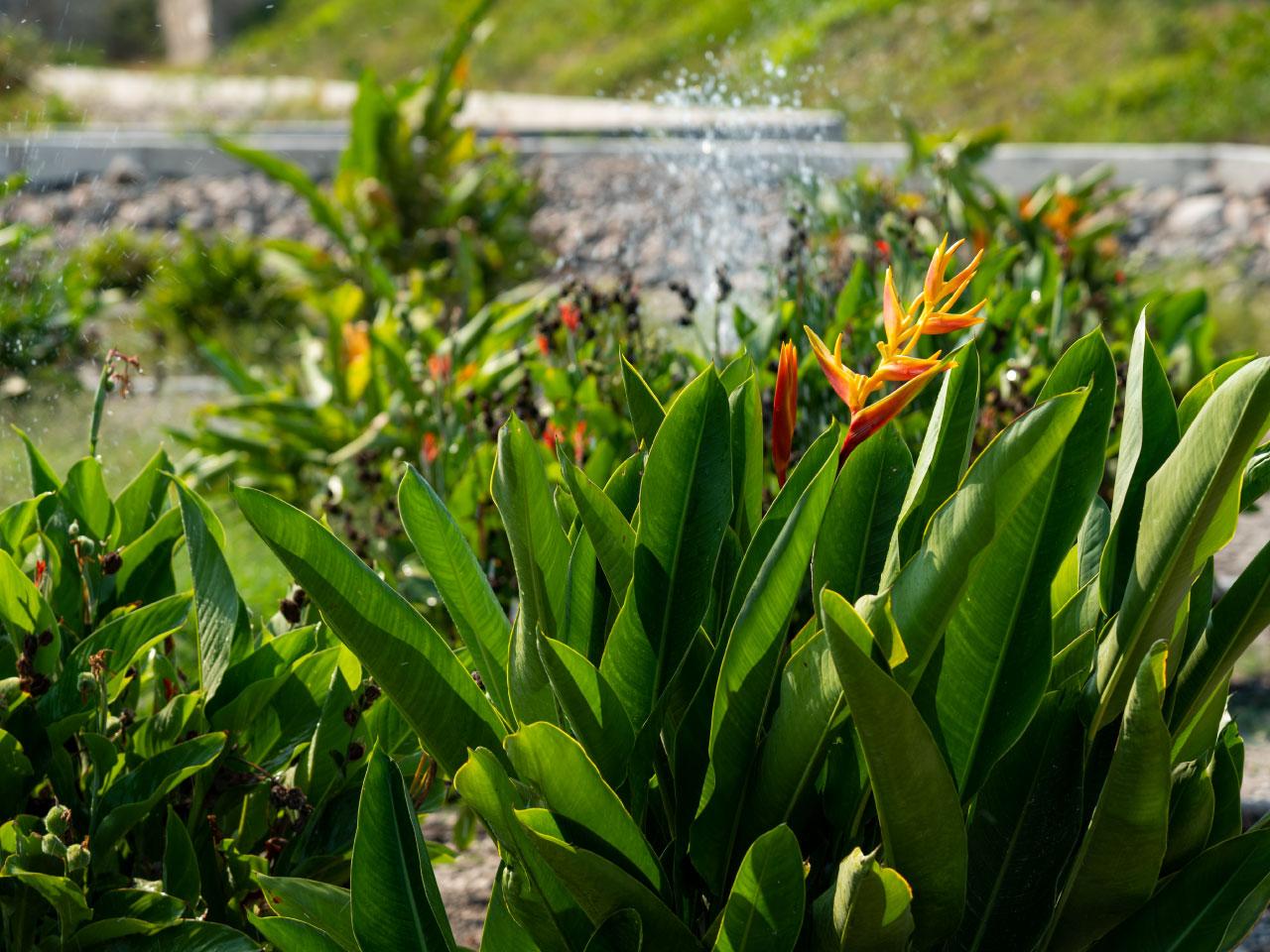
Phytoremediation plants in operation at the Cihuatlán treatment plant, Jalisco.
Cortesía de Janisch & Schulz Ingenieure
The system also contributes to the use of resources, since the management of sludge through humidification cells converts a waste into nutrient-rich humus, useful for gardening, agriculture, and soil restoration. Added to this is its energy and economic efficiency, since the operation is based on gravitational and biological processes that minimize electricity consumption and avoid the use of chemical inputs, which makes it a low-cost alternative to conventional plants.
Community linkage is another key aspect: the project has related to local productive activities, such as agroforestry nurseries and floriculture, showing that sanitation can become a community economic engine. Finally, the lessons of governance are overwhelming although, as we mentioned, the greatest risk is not technical, but political and economic. The operation requires institutional will and cooperation between the three levels of government.
Peter Detlef Anton Rossbach is a PhD candidate in biotechnological innovations at the Research and Assistance Center in Technology and Design of the State of Jalisco (CIATEJ). He has years of experience in naturebased solutions for water treatment and recirculation, especially for horticulture and aquaponics. He obtained a master’s degree in civil engineering (TU Berlin) with research in greenhouses for deserts and in the economy of the common good. He developed a concept of horticulture in arid zones based on the recovery of evaporated seawater in marine aquaculture.
José de Anda-Sánchez is a Mexican researcher with more than three decades of experience in limnology, water security and nature-based solutions for wastewater treatment. He holds a PhD in Earth Sciences from UNAM, has been director general of CIATEJ and is a member of the National System of Researchers. He has written more than 70 academic articles and five books. He is a member of the Mexican Academy of Sciences and of the Mexican Academy of Engineering and has trained generations of specialists in water management.
Jörg Karl Janisch is a German engineer specializing in environmental technology. He has over 30 years of experience in decentralized wastewater treatment and built wetland design. He has founded and directed several engineering companies in Germany, Mexico, and Paraguay, and developed projects for industries, municipalities, and resorts in Europe, Latin America, Asia, and the Middle East. He combines engineering with sustainability in construction and water management, excelling in ecological solutions for urban and industrial contexts.
Julius-Fabian Müller is an environmental engineer with international experience in business management, engineering projects, and sustainable development. His background includes project management, quality control, and team coordination in Mexico, Brazil, and Germany. As an environmental engineer, he trained in Hochschule Bremen, specializing in water treatment and renewable energies.
Authors wish to thank Janisch & Schulz Ingenieure for their willingness to share technical information, graphic material, and field experience that enriched the description of the Cihuatlán case. Their collaboration—based on years of work on the design and construction of large-scale wetlands—contributes to strengthening local capacities and advancing nature-based sanitation solutions in Mexico.
Referencias
Comisión Nacional del Agua (CONAGUA) (marzo de 2024). Estadísticas del Agua en México 2023. México. https://sinav30.conagua.gob.mx:8080/Descargas/pdf/EAM2023_f.pdf.
Hoffmann, Heike; Platzer, Christoph; Winker, Martina, & Von Muench, Elizabeth (2011). Technology review of constructed wetlands: Subsurface flow constructed wetlands for greywater and domestic wastewater treatment. Eschborn: Deutsche Gesellschaft für Internationale Zusammenarbeit (GIZ) GmbH. https://www.susana.org/_resources/documents/default/2-930-giz2011-en-technology-review-constructed-wetlands.pdf.
Janisch & Schulz Ingenieure (s. f.). “Fitotratamiento: Funcionamiento.” https://janisch-schulz.com/es/fitotratamiento/funcionamiento/.
Organización de las Naciones Unidas para la Educación, la Ciencia y la Cultura (UNESCO) (2017). Informe Mundial de las Naciones Unidas sobre el Desarrollo de los Recursos Hídricos 2017: Aguas Residuales – El Recurso Desaprovechado. https://unesdoc.unesco.org/ark:/48223/pf0000247647.
Secretaría de Medio Ambiente y Recursos Naturales (SEMARNAT) (2022). NOM-001-SEMARNAT-2021. Diario Oficial de la Federación. https://www.dof.gob.mx/nota_detalle.php?codigo=5645374&fecha=11/03/2022.
Seidel, Kathe (1966). “The use of higher plants in purification of water and waste water.” Naturwissenschaften 53. https://link.springer.com/article/10.1007/BF00712211.
UN-Habitat & World Health Organization (WHO) (2024). “Progress on the proportion of domestic and industrial wastewater flows safely treated: Mid-term status of SDG indicator 6.3.1 and acceleration needs.” https://www.unwater.org/publications/progress-wastewater-treatment-2024-update.
Vymazal, Jan (2022). “The historical development of constructed wetlands for wastewater treatment.” Land 11(2). https://doi.org/10.3390/land11020174.