Microsoft says it is 'deeply sorry' for global outage after almost 24 hours of disruption
The tech giant blames a "technical issue not related to cyber or AI" for the failure as it says services are gradually being restored.
The tech giant blames a "technical issue not related to cyber or AI" for the failure as it says services are gradually being restored.
 Jacob Phillips
Live reporter
 Image source, Reuters
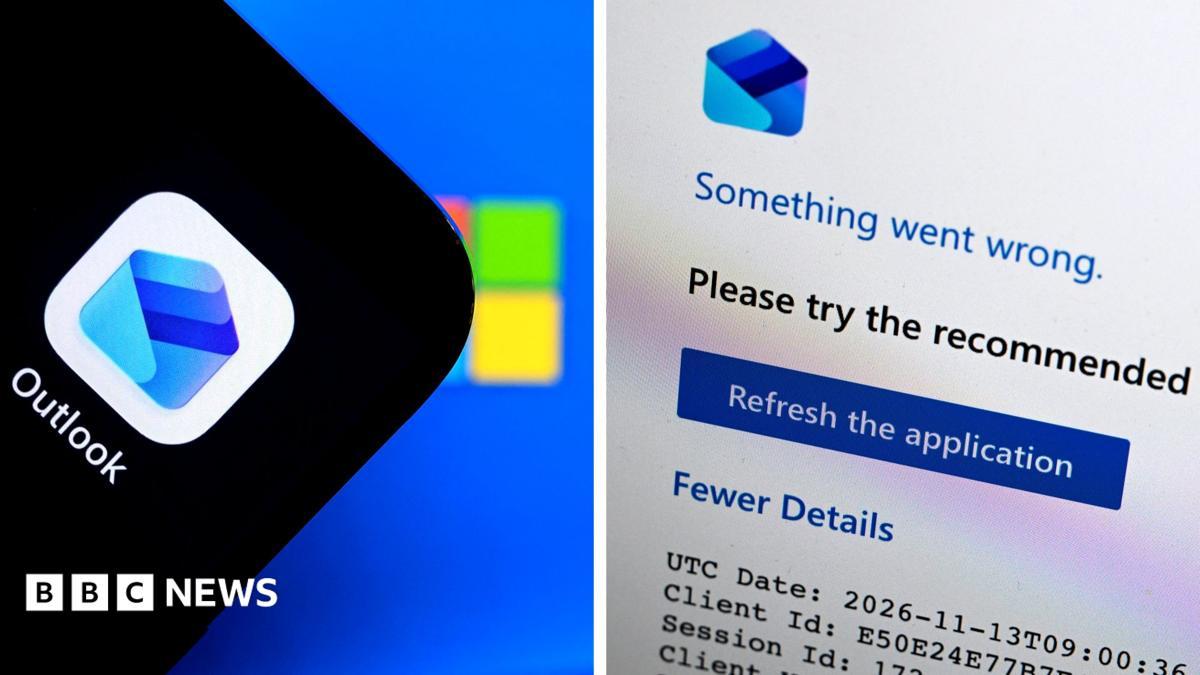
Microsoft has apologised for a global outage that left millions of users unable to access emails, it’s Teams messaging app or its AI assistant, Co-Pilot - which were inaccessible in at least 70 countries.
The US tech giant blamed a "technical issue not related to cyber or AI/agents" for the problem, saying it was introduced during an "earlier network capacity upgrade".
In the UK the outage disrupted NHS England staff. But the UK's cyber minister explained it did not affect 999 calls, front line NHS 111 services or cause transport disruption.
Hospital and rail passengers were affected in Canada while court services and government offices in the US were also disrupted - both countries are now slowly seeing operations return to normal.
We heard from a South African winemaker who was unable to process orders to Europe - but some enjoyed the pause in work emails – one entrepreneur in Tanzania headed to read on the beach.
The global impact will be "absolutely massive" as Microsoft sits at the heart of many businesses, a cyber-security adviser explained.
Microsoft has said it is working to restore services gradually due to the "scale of demand".
Microsoft says it is "still draining queued messages and rebalancing traffic" following the earlier global outage.
It warns in its latest update some customers may see improved access, but it does not know when a full recovery will be complete.
 Image source, Getty Images
The Microsoft outage highlights the "lack of resilience" in the UK's digital infrastructure, the chair of the House of Commons science and technology committee says.
Chi Onwurah says the incident also shows the dangers such a dependency can post to the country's security, economy and public services.
The committee previously published a report which stated the UK's reliance on a small number of US-based providers for digital infrastructure and public service delivery is a "strategic and economic vulnerability".
The prime minister's deputy spokeswoman said a range of services experienced disruptions today due to parts of government using Microsoft services.
Disruption was also reported by the Welsh government, which said it's "using contingency arrangements as needed".
In Northern Ireland, education and council services were interrupted, with Belfast City Council saying there were issues "receiving and responding" to emails.
And in Scotland, some systems were hit by the outage, with the Scottish justice secretary telling the BBC the government's "resilience operation" had been activated.
 Laura Cress
Technology reporter
 Image source, Reuters
A global Microsoft outage lasting more than 22 hours raises questions about how much we rely on a handful of tech firms.
Flora Hamilton, executive director of the Small Business Charter, says it is a "stark reminder" of how much firms "rely on digital systems”.
"For many small and medium-sized enterprises, access to email is fundamental to everything from communicating with customers and suppliers to generating income," she says.
Artificial Intelligence strategist Walter Pasquarelli tells the BBC that for governments, businesses and critical infrastructure, the outage puts "their vulnerabilities and dependence in plain sight".
"Looking ahead, as AI assistants are plugged into our email, calendars and files, a failure like this may spread even further," he says.
Gergely Orosz, a former leading software engineer at several major tech companies, says what was unusual about this outage was the time it took for Microsoft to recover. The resulting upset shows "our reliance on a few large US corporations".
A spokesperson for Microsoft said "given the scale of demand" it restored services gradually.
Tom Espiner
Business reporter
Microsoft may face compensation claims over the Outlook outage, but there would be lots of potential pitfalls for would-be claimants, a lawyer says.
Whether an organisation or individual would stand a chance of success in getting any compensation from Microsoft would depend on the nature of the contract they have with the tech giant.
Customer terms, especially for free versions of Outlook, usually specify that Microsoft is not liable for service interruptions, and courts normally uphold these contracts if the terms are reasonable, says Riah Sattar, a partner and head of dispute resolution at Thomas Mansfield Solicitors.
Businesses or individuals using paid-for versions of Outlook are partly protected under the Consumer Rights Act in the UK, which says that paid-for services must be delivered with reasonable care and skill.
However, the claimant would have to show that Microsoft was liable for something it had control over, which is difficult to do.
The claimant would also have to show that the outage caused them a loss.
As Microsoft systems continue to come back online following more than 20 hours of disruption, readers have been getting in touch with the BBC to describe their experiences.
It is fair to say some have had it better than others:
 Image source, PA Media
Cyber minister Liz Lloyd has explained there has been "limited" impacts on frontline services
The UK cyber minister says the Microsoft outage has "mainly affected back-office functions such as messaging and email" and the government has seen "limited" reports of impact on frontline service delivery.
Liz Lloyd says 999 calls and NHS 111 services have been unaffected by the disruption and that HMRC and DWP phone lines are "fully operational" - although people may have had longer than usual waiting times.
She adds there has been no disruption to the transport network as a result of the outage.
Lloyd adds she has spoken to the CEO of Microsoft UK about their plans for a full return to normal services "as soon as possible".
She explains Microsoft is "seeing positive results".
"The government recognises this incident has been inconvenient and disruptive," she says.
"Affected departments and public sector organisations have plans in place for these events to mitigate potential impacts and continue their business operations."
Lloyd adds that the government will review the incident and use the lessons learnt to "inform our ongoing work to raise digital resilience across the UK".
 Madeline Halpert
Reporting from New York
 Image source, Getty Images
Via Rail in Canada says despite the technical issues, services are running as normal
Earlier, we pointed to a number of entities that had been impacted by the global outage.
Some of those affected are now seeing operations back to normal, including the Arapahoe County Sheriff's Office in Colorado, which said people being detained are now able to make bond payments online again.
Unity Health Toronto, which had said earlier that patients and doctors may struggle to reach each other, says on their website that "email services are gradually returning to normal as Microsoft works to restore services".
Others, like several municipal governments in the US impacted by the outage, had yet to provide an update on whether emails were working again on Friday afternoon.
 Tinshui Yeung
Live reporter
 Image source, Downdetector
Website Downdetector noted hundreds of reports on Thursday evening and Friday morning
All timestamps are in GMT, according to posts published on X.
12 November 17:54: Microsoft first acknowledges reports that users in the Americas are unable to access Exchange Online mailboxes.
18:07: Microsoft warns that the disruption may affect Microsoft 365 connectivity globally, not just in the Americas.
19:31: The company says an investigation found that a number of services had become “unexpectedly unavailable”, straining the remaining infrastructure.
19:50: Engineers start focusing on an issue that caused servers to fail automated health checks and become unavailable.
23:04: Microsoft says it’s returning some affected servers to service, and they “remain stable”.
13 November 00:06: Microsoft says servers returned to service can become unresponsive again once they receive traffic, and it is analysing the data to find out why.
04:36: After a series of efforts, Microsoft says it is seeing “partial recovery” in some regions.
09:24: “We’re seeing early stabilization and capacity improvements as recovery actions continue,” the company says.
13:32: The company says there are “broader improvements” in North America, “sustained improvements” across much of Europe and “encouraging recovery signals” in the Asia Pacific region.
14:17: The company says it’s continuing to see improvements, with email queues “significantly reduced and approaching normal levels”.
15:39: Microsoft says it's "seeing encouraging recovery process", and confirms that "there is no indication this is the result of malicious or cyber activity".
Microsoft says that the disruption has been caused by a "technical issue not related to cyber or AI/agents".
In a statement sent to the BBC, a Microsoft spokesperson says it is "deeply sorry" for the disruption and says it takes its responsibilities "extremely seriously".
The statement explains: "The incident was introduced by an issue during an earlier network capacity upgrade that surfaced following a recent network change.
"We have addressed the underlying issue and continue to restore service to remaining customers and regions."
Microsoft says it is restoring services gradually due to the "scale of demand" and it will provide a full post-incident report once its review is complete, the spokesperson adds.
 Jack Grey
Live reporter
 Image source, Getty Images
Microsoft services are slowly returning online after a global outage impacted millions of users around the world.
What has happened?
The impact
While services are now returning online, that doesn't mean everything is working perfectly behind the scenes - expect some delayed emails for a while yet, writes BBC tech reporter Tom Gerken.
Despite the disruption, shares in Microsoft only dipped 0.2% in early trading after the US stock market opening, suggesting investors are not all that worried about what the outage.
Meanwhile, one cyber security expert has warned users to be wary, telling the BBC cyber criminals will likely capitalise on the disruption in an attempt to steal sensitive data.
 Joe Tidy
Cyber correspondent
 Image source, Getty Images
The exact words Microsoft is using are: "As of now, we are not aware of any malicious activity that is causing this incident.”
This assessment might change of course.
Right now, the priority is not to find out the root cause, but to get millions of people back online. So, any investigation into what triggered this enormous outage can wait.
But the chances of this being some kind of cyber-attack are low - if we judge history.
None of the mega outages of recent years have been down to a malicious cyber-attack. Dull technical glitches, human error, or expired software certificates are usually the culprit.
For example - “it’s always DNS” is an ongoing joke in the IT world referring to the frequently problematic Domain Name System. There are even t-shirts made with the slogan written on them.
It’s not always DNS of course. But the joke encapsulates the problem of our modern digital world where there are single points of failure that can bring down millions of users with them.
Microsoft says it remains focused on "addressing residual impact" and ensuring that services are reliably restored.
In its latest hourly update - separate from the one released by Charles Lamanna a few moments ago - it says it is continuing to "assess recovery across various connection methods and [is] closely monitoring service health to verify sustained stability".
We've just had an update from Microsoft executive Charles Lamanna, who says there is encouraging recovery progress.
Here is his statement in full:
"We're seeing encouraging recovery progress, with service availability and email delivery performance improving across a growing portion of affected infrastructure.
"We know our customers rely on our services to get important work done every day and regret the impact these outages had on those who depend on us.
"Our teams are reviewing what happened and how we can prevent similar issues going forward."
 Nick Johnson
Reporting from London
The Golden Goose pub is tucked inside Leadenhall Market in the heart of the City of London.
While many of the customers joked with me earlier that they would “be here at this time on a Friday anyway,” one group of drinkers confessed they would have been in the office had it not been for the Microsoft outage.
This group of five work in banking and told me they’d arrived at work as normal today, but had “given up” by late-morning as the email system was down.
“Everyone in the office decided that at around 11:00, if the emails weren’t going to go back on, it was time to go to the pub,” Pippy Isaacs tells me.
 Shiona McCallum
Senior technology reporter
 Image source, Getty images
Cyber security expert Ken Munro warns businesses and individuals who have been switching to messaging apps during the Microsoft outage could potentially put personal data at risk.
"If email is down, many will move to WhatsApp and other platforms, so there's a risk to sensitive data being shared on less secure platforms," he says.
Munro says email outages and cyber events like this are "a prime time for scammers".
He warns fake support messages about the outage could be used to "extract passwords from people and install malware".
The warning, as ever, during these cyber security incidents is to be careful of clicking on links and pause if something doesn't look right.
Be vigilant.
 Tom Gerken
Tech reporter
 Image source, Getty Images
By now, people will be finding they're able to access Outlook again, but that doesn't mean everything is working perfectly behind-the-scenes.
Microsoft has warned of "intermittent access issues" - meaning some folk will struggle to load their inbox - as well as "delayed email delivery".
In other words, at the moment it's not quite safe to assume every email you send is going to show up in its intended recipient’s inbox right away.
In fact, you might say there's a bit of an email "gap", where there could well be a bunch of emails waiting for you that have yet to arrive.
And of course, when they do show up the timestamp will be when the email was delivered - not when it was sent.
So don't be too surprised if you end up receiving a few emails that look like they were sent at odd times as the rest of the day rolls on.
 Mitchell Labiak
Business reporter
 Image source, Reuters
Shares in Microsoft dipped 0.2% in early trading in the US, suggesting that investors are not all that worried about what the outage could mean for the tech giant.
It seems remarkable considering the immense amount of disruption the outage has caused around the world, but share price movements depend on earnings predictions, not public sentiment.
As such, for Microsoft investors, there are only two big questions today: Will the firm be liable for compensation as a result of this issue? And will its customers cancel their subscriptions to its services en masse in response?
The share price movement, or lack thereof, implies that the majority of traders believe the answer to both of those questions is "no".
Microsoft says it is seeing "sustained improvements in service availability as recovery progresses across affected Microsoft 365 services".
In its latest update Microsoft warns that some users may continue to struggle to connect or their emails may be delayed.
Ewan Somerville
Reporting from Westminster Magistrates' Court
The Microsoft outage has had a knock-on effect at some courts across the country - including here at Westminster Magistrates' Court.
A member of court staff told me they had experienced "a lot of delays as the whole system has been down".
"It's been stressful," she says. "Judges have been unable to access systems, the prosecution hasn't been able to send papers through, and we've been unable to get pre-sentence reports."
I saw huddles of defendants and their legal teams waiting for each courtroom to become available.
But it was orderly and did not feel chaotic. As I left early on Friday afternoon, some of the court's systems were coming back online and staff were working to catch up on dozens of listings for extradition cases and others.
A Ministry of Justice source told me: "Courts are still operating, and we have contingencies in place, obviously everything is a bit clunky as we look to manage the situation."
Texto de bbc.com tal como lo publicó, leído de su página y mostrado aquí con el formato de El Autómata. El original, en bbc.com · Volver a la noticia de El Autómata