Todos los periódicos y la radio, en unoEscrito por IA a partir de Hacker News · Cómo se hace
Hacker News
Sections on this page:
Commodore PET History
Commodore PET Manuals, Brochures & Magazine Articles
Commodore PET Games, Downloads, ROMs, Screen Shots, Reviews
Commodore PET Chronology
Commodore PET Hardware Identification
Commodore PET Picture Gallery
Commodore PET Videos
Commodore PET History:
Written by Ian Matthews in February 2003
Last Updated Nov 29 2018
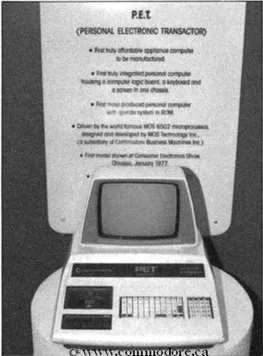
First announced and demonstrated in January of 1977 at the Consumer Electronics Show in Chicago, months before the Apple II or Radio Shack TRS80, the Commodore PET was the worlds first Personal Computer. (See the note at the bottom of this page for a verification of this date).
The PET came fully functional out of the box with:
a keyboard including a separate numeric pad (almost completely unheard of at the time, even as an option)
a 9″ integrated Blue and White monitor
a main board with the powerful new 1 Mhz MOS 6502 processor
many expansion sockets additional RAM or a Processor board
4K of memory
power supply
a cassette tape drive which was a practical storage device for the time
several expansion ports including an RS232 (serial) port
ability to handle and create fantastic graphics (for the time)
upper and lower case text
an operating system that was burned onto a ROM chip and loaded on boot… WOW that was cool
All this was wrapped up in a solid steel, good looking, white chassis. The prototype PET’s chassis (shown in the photo at the top of this page) used rounded edges that was likely designed by Ira Velinsky. Commodore was a notable manufacturer of metal filing cabinets so when it came time for production, they decided to use the now familiar square cases to keep production costs down.
Altair 8800, Southwest Technical 6800, IMSA 8048, Processor Technology SOL
The PET was a revelation as all previous home computers were little more than circuit boards that could only be understood by hard core enthusiasts like the members of the Home Brew Computer clubs.
Inside the Commodore PET
The first prototype PET demonstrated at the 1977 Consumer Electronics Show had been cobbled together in a hurry and on the cheap. It had a chassis made of wood and a picture tube taken from a $90 black and white TV that MOS bought from a local hardware store.
The visionary engineer behind this project was Chuck Peddle. The worlds first Personal Computer was not ready even a week before the show and in the three days leading up to CES, Chuck worked 20 hours a day getting the PET prototype functional; he completed this now historic task only a few hours before the doors opened.
A year earlier, in the spring of 1976 Chuck Peddle, who worked not for Commodore but for MOS Technologies‘, completed development of the versatile and very inexpensive MOS 6502 processor. He and his largely ex-Motorola colleagues developed the KIM-1 “Computer Trainer” to show off the functionality of this landmark new chip but that was only the start. Chuck developed the PET concept and took it to Radio Shack hoping to have them retail it for him but they were not interested. Soon after, in the summer of 1977, Commodore’s founder Jack Tramiel took a three million dollar loan guarantee from Canada’s Irving Gould to buy Pennsylvania based MOS Technologies, its staff, its patents, it production facilities, along with the PET concept.
Commodore PET 2001 Chicklet Keyboard 1978
At the time Commodore manufactured office equipment like filing cabinets but its biggest business was in calculators so it is no surprise that the original production Commodore PET 2001’s had a sheet metal chassis and calculator style keys dubbed “chiclet keyboards”. These 47 pound beasts were all manufactured in Commodore’s original (and short lived) U.S. facility located in Palo Alto California.
There are several rumours about the source of the name PET. Officially it was an acronym for Personal Electronic Transactor, but P.E.T. are also the initials of founder Jack Tramiel’s wife. Whatever the origin, Jack thought that PET “sounded” good and would have some positive linkage with the Pet Rock fad of the late 1970’s.
The PET made the cover of the October 1977 Popular Science, had a small write up in the February 1978 Playboy and had a very interesting and detailed review from the cover of the February 1978 Electronics Today.
During the first few months Commodore could only produce about 30 machines per day so they could not meet the huge demand. They managed to assemble a meager 500 machines in its first year.
UK PET Advert – Kit Spencer – Choose Commodore Software
The four kilobyte PET’s (yes that is 4096 bytes which equates to a whopping 4096 characters!) were offered through mail order for $495 and a three to six week wait. Immediately orders starting pouring in and so Jack Tramiel quickly adjusted the price to $595. Then the $795 8K model was actively promoted and the 4K model was downplayed by indicating 8K machines would ship much sooner than 4K machines.
When Commodore expanded to Europe in 1978 Jack doubled the price for the same machine but the only physical change was a 220 watt power supply. The UK \ EU models were sold under the Commodore PET 3008 3016 and 3032 badges. As was almost always the case in those days, Jack’s instincts were right; the re-branded but otherwise identical 3000 series and related future models were highly successful in the European markets at the higher prices.
CBM Brochure – Meeting The Needs of Professionals
The COMMODORE BASIC Operating System was written by Bill Gates and Paul Allen from their fledgling Micro-Soft Corporation (later renamed to Microsoft Corporation). Commodore Basic was the only unlimited software license ever granted by Microsoft to any company for all products regardless of the number of copies used. Commodore went on to produce literally millions of machines with various forms of Commodore Basic and did not pay Microsoft a single cent beyond the initial licence purchase in 1976/7.
The PET was a big hit and in these early days of computers. Commodore was receiving as many as 50 requests a day from small, would be computer stores that wanted to sell the PET. Jack was in the luxurious position of being able to pick and choose his dealers. He insisted all stores have:
a good business history
a retail store front
an in store service technician
a parts inventory, and most importantly
pay Commodore a cash deposit in advance for all orders
Commodore PET plus 2041 Floppy Disk Drive
Within a year Commodore had enough negative feedback about their almost unusable chiclet keyboard that they decided to introduce a standard keyboard model. To make space for the “real” keyboard, they had to remove the integrated cassette tape drive. Just after that, the expensive metal cases were replaced with cheaper plastic cases. By 1980 the PET had a massive 12″ green and white monitor version, dubbed the “Fat 40” which later became standard.
I recall buying my Commodore PET 4016 with 9″ screen, tape drive and a 2031 170K single floppy drive for about CDN$2000 (adjusting for inflation that is about $6000 in 2018!) from my local dealer in Belleville, Ontario in about 1980. I still own that equipment and all devices work like the day they left the factory. (Click on the keyboard picture to the right to see that PET.) At the time Canadian $ were just better than ‘par’ with American $ and that Commodore was a Canadian company with serious operations in Toronto, just a two hours from my house.
Commodore Education Brochure – PET, SuperPET, 2041 Disk, VIC-20, Printers
Commodore developed many revisions of the PET hardware and firmware, perhaps the most interesting of which is the SuperPET. Using Ontario Canada’s University of Waterloo, Commodore developed the worlds first “co-processor computer”. The Commodore SuperPET was a standard Commodore PET 8032 with 6502 processor, plus an integrated expansion board that carried a Motorola 6809 processor and 64K more memory. In fact there was an $795 ($1750 in 2018 dollars) upgrade kit to convert your 8032 into a SuperPET. The SuperPET manufacturing was contracted to BMB CompuScience of Milton Ontario, Canada.
There were two small toggle switches under the right side of the chassis to change which CPU was in use and in what mode the machine was to operate. The SuperPET ran Waterloo MicroAPL, MicroFORTRAN, MicroBASIC, MicroPASCAL, MicroCOBOL in addition to the standard Commodore Basic v4. It was to be used primarily by scientists and students to work off-line from a company’s or school’s mainframe. A SuperPET could be easily connected to a mainframe and upload whatever was achieved while off-line (i.e. debugged APL code, processed data…). At a time when mainframes cost hundreds of thousands of dollars, the SuperPET was truly an innovative machine with the low low retail price tag of just $2795 (adjusting for inflation that is about $6000 in 2018).
By 1982 PET sales were declining with increased competition and Commodore decided to refresh the line with what Commodore called the CBM-II line: the “B” and “P” Series were conceived. These machines came in many different configurations including ones that did not have integrated monitors. These were the first production computers to sport the snappy Ira Velinsky designed round case which won an international Industrial Design award.
The “P” or Personal Series machines were demonstrated at trade shows and a small number of beta machines were released to Canadian and American dealers to show to prospective clients what they could do. Unfortunately many dealers sold those demo machines. In case you don’t know, beta means pre-release and not finished. As such these beta machines were buggy so they P Series PET’s got a bad name before they were even released. Commodore also thought that the new P Series would cut into their exploding Commodore 64 business so they cancelled the P line all-together. All of the P128 inventory that Commodore was able to retrieve from dealers was plowed into a land fill.
“B” or Business Series machines on the other hand were released in both North America and Europe. A top of the line Commodore B had some very impressive specifications:
two integrated 5.25″ drives with a 1MB of capacity (in 1983!)
128K of RAM expandable to a mind boggling 1MB
powerful 6509 CPU at 1Mhz
potential access to almost every piece of PC business software on the planet (see below)
Zilog Z80 co-processor board that would allow MS DOS 1.25 and CP/M-86 programs to operate
there are only three known 8088 cards in known existence today (2001)
the only programs that were ever developed to run on these cards were “MS-DOS 1.25 for Commodore B Series” and a developer version of CPM-86 (i.e. no real software)
the remarkable Commodore SID sound chip
high resolution graphics
separate keyboard
integrated 80 column, 12″ Display with swivel base (the P Series was colour!)
integrated Commodore Basic Version 7
a smooth, round, sexy case… still today the best looking computer ever mass produced
Even with all this functionality Commodore failed to sell the B Series PET’s in quantity and did not support it with very many “B” specific new programs.
As was always Commodore’s want, they refused to support any of its products with much in the way of advertising. This was the time when other world wide companies like IBM had an advert in every magazine and every night on TV. From the start the B was doomed. Most of the B Series units were sold in Europe, including the West Germany manufactured C710 ‘high boy’ that I own. The most popular B was the B-128 and in the end Commodore managed to sell a measly 15,000 units globally.
Just before Commodore was to plow under the B Series schematics, test machines, and prototype expansion cards, they did what no other computer company had (has?) ever done; hand-over these engineering assets to a third party without charge. The Chicago B128 Users Group (CBUG) became the keeper of all things “B”.
CBUG worldwide members bought hundreds of machines from a company called