Drought shifts more plant root cells into newly discovered environmental response mode · Phys.org · El Autómata
Lunes, 16 de noviembre de 2026
Portada de las 21:20
Todos los periódicos y la radio, en unoEscrito por IA a partir de 26 medios · Cómo se hace
Biología y genética
Phys.org · texto original · Plants & Animals
Drought shifts more plant root cells into newly discovered environmental response mode
Scientists have discovered a hidden layer of identity in plant root cells: an "environmental mode" that switches on in some cells and becomes more common when water is scarce. The study, led by Dr. Marina Oliva and professor Ryan Lister, from the ARC Center of Excellence in Plants for Space and The University of Western Australia's School of Molecular Sciences, examined how plant cells responded to drought conditions. The work is published in Nature
Foto: vía Phys.org
Annelies Gartner · Phys.orgPublicado 22 oct, 18:40Ver en phys.org
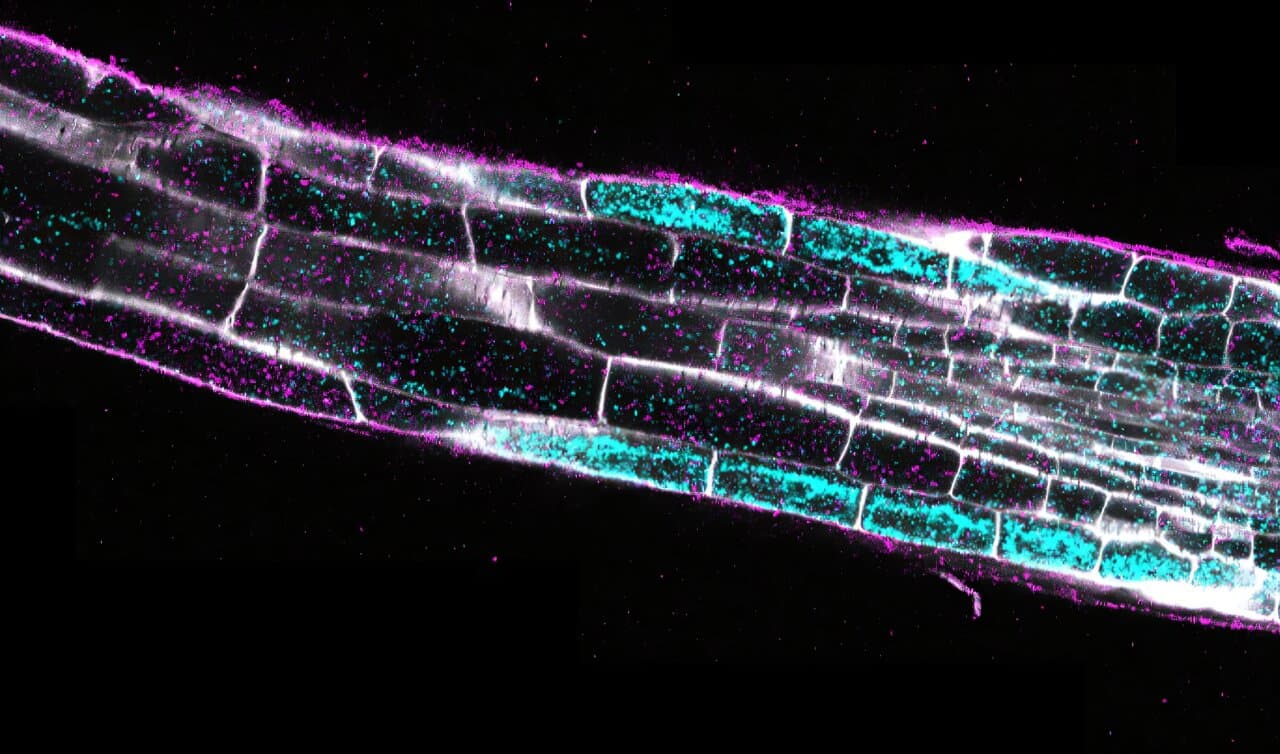
Mean signal intensity for genes AT3G01720 (blue) and AT5G56550 (pink) in Arabidopsis root. Credit: Adapted from Nature (2026). DOI: 10.1038/s41586-026-11179-y
"Roots have long been described as a set of well-defined, distinct cell types, each following a single path from young cell to mature cell," Oliva said.
Researchers read the gene activity of hundreds of thousands of individual cells from the root tip of the model plant Arabidopsis. They found that almost every cell type splits into two groups: cells that switch on a shared set of hundreds of genes involved in responding to environmental conditions and cells that do not switch these on.
"We expected each cell type to have one story, but instead found that every cell type has two," Oliva said. "What separates them is that one group activates an extra set of genes linked to environmental responses.
"What was really striking was that when we changed the growing conditions, the root responded by changing how many cells switched on this extra program."
The response was influenced by abscisic acid, the plant hormone that coordinates drought responses. Plants unable to make or sense the hormone had far fewer cells in this mode, while plants grown with limited water had many more, rising from about 4 in 10 cells to 2 in 3.
Lister, from UWA and the Harry Perkins Institute of Medical Research, said the discovery had been invisible to older methods of analysis that averaged thousands of cells together. "Plants can't move to escape bad conditions, so they need ways to adapt to changes in their environment," Lister said. "This discovery suggests that one way roots do this is by shifting the balance between the two states their cells can adopt, almost like turning a dial.
"Understanding how roots respond to water and nutrients is central to growing crops that cope with drought on Earth, and to growing plants in the controlled environments of vertical farms and space missions."
Publication details
Marina Oliva et al., An environmentally regulated dichotomy in cell lineages of the root, Nature (2026). DOI: 10.1038/s41586-026-11179-y
Bachelor's in mathematical biology, Master's in creative writing. Well-traveled with unique perspectives on science and language.
Full profile →
Citation:
Drought shifts more plant root cells into newly discovered environmental response mode (2026, October 22)
retrieved 16 November 2026
from https://phys.org/news/2026-10-drought-shifts-root-cells-newly.html
This document is subject to copyright. Apart from any fair dealing for the purpose of private study or research, no
part may be reproduced without the written permission. The content is provided for information purposes only.