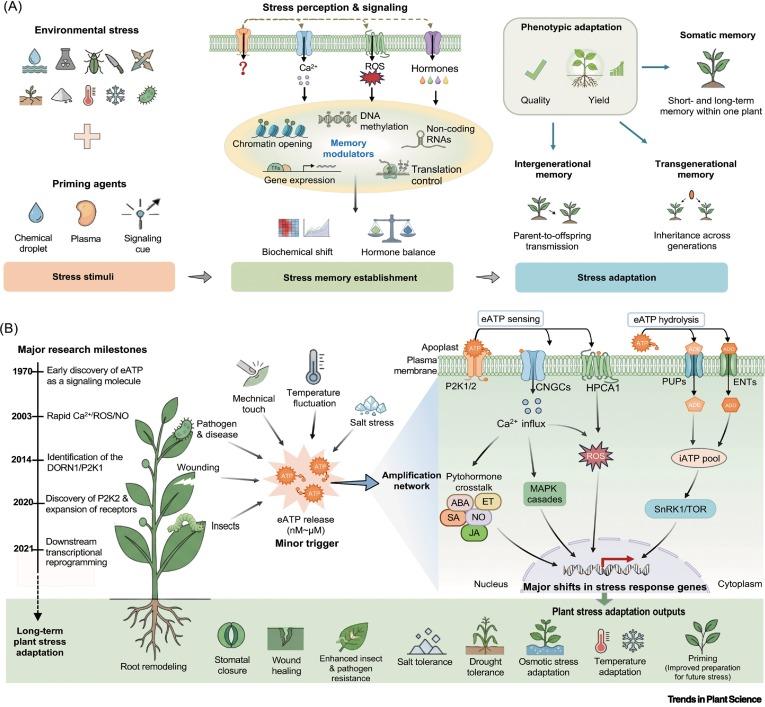
Highlights
Extracellular ATP acts as a damage-associated molecular pattern that bridges acute stress perception to long-term memory via the purinoceptor 2K1/2 receptors and a tripartite Ca2+–reactive oxygen species–mitogen-activated protein kinase signaling cascade.
Extracellular ATP signaling interfaces with hormone networks and energy sensors (target of rapamycin–sucrose non-fermenting-1 related kinase 1) to enable context-dependent priming, systemic propagation, and chromatin-based stress readiness.
Modulating extracellular ATP homeostasis or receptor activity enhances cold, drought, and biotic stress tolerance in crops.
Positioning extracellular ATP as an integrative primer for breeding climate-resilient plants and developing ATP-based biostimulants.
Abstract
Keywords
- extracellular ATP
- eATP receptor
- stress priming
- plant memory
- cross-tolerance
Get full text access
Log in, subscribe or purchase for full access.
References
1.
Liu, H. ...
Priming crops for the future: rewiring stress memory
Trends Plant Sci. 2022; 27:699-716
2.
Arıkan, B. ...
Epigenetic and transcriptomic features of stress memory during salt-stress priming in Arabidopsis
Plant Sci. 2026; 362, 112775
3.
Staacke, T. ...
Stress resilience in plants: the complex interplay between heat stress memory and resetting
New Phytol. 2025; 245:2402-2421
4.
Hemenway, E.A. ∙ Gehring, M.
Epigenetic regulation during plant development and the capacity for epigenetic memory
Annu. Rev. Plant Biol. 2023; 74:87-109
5.
Choi, J. ...
Identification of a plant receptor for extracellular ATP
Science. 2014; 343:290-294
6.
Pham, A.Q. ...
Arabidopsis lectin receptor kinase P2K2 is a second plant receptor for extracellular ATP and contributes to innate immunity
Plant Physiol. 2020; 183:1364-1375
7.
Shan, Y. ...
Advances in chilling injury of postharvest fruit and vegetable: extracellular ATP aspects
Compr. Rev. Food Sci. Food Saf. 2022; 21:4251-4273
8.
Xiao, J. ...
ATP homeostasis and signaling in plants
Plant Commun. 2024; 5, 100834
9.
Yuan, D.P. ...
Extracellular ATP: an emerging multifaceted regulator of plant fitness
Plant Biotechnol. J. 2025; 23:1771-1782
10.
Kim, D. ∙ Stacey, G.
Phosphorylation-mediated regulation of integrin-linked kinase 5 by purinoreceptor P2K2
Plant Signal. Behav. 2023; 18, 2261743
11.
Shan, Y. ...
Role of apyrase-mediated eATP signal in chilling injury of postharvest banana fruit during storage
Postharvest Biol. Technol. 2022; 187, 111874
12.
Sun, Y. ...
Activation of the CNGC2-CNGC4 channel complex by P2K1-mediated phosphorylation links extracellular ATP perception to calcium signaling in plant immunity
Mol. Plant. 2025; 18:1130-1142
13.
Jewell, J.B. ...
Jasmonate primes plant responses to extracellular ATP
Plant J. 2025; 124, e70514
14.
Wang, L. ...
Arabidopsis thaliana CYCLIC NUCLEOTIDE-GATED CHANNEL2 mediates extracellular ATP signal transduction in root epidermis
New Phytol. 2022; 234:412-421
15.
Lim, C. ...
Global transcriptome analysis of rice seedlings in response to extracellular ATP
Rice Sci. 2025; 32:380-399
16.
Kundu, P. ...
The Arabidopsis eATP receptor DORN1 and CNGC19 calcium channel act in tandem to regulate plant defense upon Spodoptera litura herbivory
J. Exp. Bot. 2025; 76:2264-2277
17.
Chen, D. ...
Extracellular ATP elicits DORN1-mediated RBOHD phosphorylation to regulate stomatal aperture
Nat. Commun. 2017; 8:2265
18.
Shan, Y. ...
Adenine regulates chilling injury via energy signaling salvage by purine permease MaPUP4 in banana fruit
Postharvest Biol. Technol. 2026; 233, 114059
19.
Aghdam, M.S. ...
Ensuring sufficient intracellular ATP supplying and friendly extracellular ATP signaling attenuates stresses, delays senescence and maintains quality in horticultural crops during postharvest life
Trends Food Sci. Technol. 2018; 76:67-81
20.
Clark, G. ...
Levels of extracellular ATP in growth zones of Arabidopsis primary roots are changed by altered expression of apyrase enzymes
Plant Signal. Behav. 2025; 20, 2555965
21.
Zhang, Y. ...
Extracellular ATP receptors P2Ks are involved in regulating systemic calcium of Arabidopsis in response to local NaCl stress
Plant Physiol. Biochem. 2025; 222, 109734
22.
Zhang, Y. ...
Extracellular ATP receptors P2Ks play a role in regulating local and systemic ROS accumulation of Arabidopsis thaliana seedlings in response to local salt stress
Physiol. Plant. 2025; 177, e70381
23.
Kim, D. ...
The Raf-like MAPKKK INTEGRIN-LINKED KINASE 5 regulates purinergic receptor-mediated innate immunity in Arabidopsis
Plant Cell. 2023; 35:1572-1592
24.
Dong, X. ...
LRK10L3 and BAK1 are collaboratively involved in extracellular ATP-regulated seedling growth of Arabidopsis thaliana
New Phytol. 2025; 247:2709-2725
25.
Sowders, J.M. ...
CPK28 is a modulator of purinergic signaling in plant growth and defense
Plant J. 2024; 118:1086-1101
26.
Sowders, J.M. ...
FERONIA orchestrates P2K1-driven purinergic signaling in plant roots FERONIA orchestrates P2K1-driven purinergic signaling in plant roots
Plant Signal. Behav. 2024; 19, 2370706
27.
Chen, D. ...
S-acylation of P2K1 mediates extracellular ATP-induced immune signaling in Arabidopsis
Nat. Commun. 2021; 12:2750
28.
Myers, R.J. ...
Extracellular ATP plays an important role in systemic wound response activation
Plant Physiol. 2022; 189:1314-1325
29.
Fejes, G. ...
Nitric oxide as an integral element in priming-induced tolerance and plant stress memory
J. Exp. Bot. 2025; 76:3669-3685
30.
Che, Y. ...
Extracellular adenosine triphosphate functions downstream of hydrogen sulfide in ethylene-induced stomatal closure in Arabidopsis thaliana
Chin. Bull. Bot. 2015; 50:22-31
31.
Tang, W. ...
Extracellular ATP inhibits root gravitropism at concentrations that inhibit polar auxin transport
Plant Physiol. 2003; 131:147-154
32.
Jeter, C.R. ...
Evidence of a novel cell signaling role for extracellular adenosine triphosphates and diphosphates in Arabidopsis
Plant Cell. 2004; 16:2652-2664
33.
Li, J. ...
BAK1, an Arabidopsis LRR receptor-like protein kinase, interacts with BRI1 and modulates brassinosteroid signaling
Cell. 2002; 110:213-222
34.
Fichman, Y. ∙ Mittler, R.
Integration of electric, calcium, reactive oxygen species and hydraulic signals during rapid systemic signaling in plants
Plant J. 2021; 107:7-20
35.
Deng, S. ...
Populus euphratica APYRASE2 enhances cold tolerance by modulating vesicular trafficking and extracellular ATP in Arabidopsis plants
Plant Physiol. 2015; 169:530-548
36.
Shan, Y. ...
Specific binding of NTP to MaDORN1.19 enhances cold tolerance of postharvest banana fruit during storage
Postharvest Biol. Technol. 2022; 188, 111883
37.
Li, Y. ...
Musa acuminata calmodulin-binding transcription activator 4 enhances fruit quality maintenance of banana during cold storage
Food Chem. 2026; 528, 151026
38.
Zhou, Y. ...
Functional analysis of LcDORN1 genes in the senescence of litchi fruit
Postharvest Biol. Technol. 2024; 218, 113186
39.
Huang, T. ...
Mitigation of chilling injury in mango fruit by methyl jasmonate is associated with regulation of antioxidant capacity and energy homeostasis
Postharvest Biol. Technol. 2024; 211, 112801
40.
Zeng, X. ...
CK2 kinase–PRC2 signalling regulates genome-wide H3K27 trimethylation and transduces prolonged cold exposure into epigenetic cold memory in plants
Nat. Plants. 2025; 11:1572-1590
41.
Liu, J. ...
An H3K27me3 demethylase-HSFA2 regulatory loop orchestrates transgenerational thermomemory in Arabidopsis
Cell Res. 2019; 29:379-390
42.
Wu, F. ...
eATP activates energy dynamic gene GhG6PD to improve salt tolerance in cotton
Plant Physiol. Biochem. 2025; 229, 110553
43.
Huang, Y. ...
Chromatin remodeling in plants: complex composition, mechanistic diversity, and biological functions
Mol. Plant. 2025; 18:1436-1457
44.
Wang, X. ...
Nutrient-driven TOR signalling controls a chromatin-associated complex for orchestrating plant growth and stress tolerance
Nat. Plants. 2025; 11:2115-2129
45.
Wang, W. ...
SnRK1 stimulates the histone H3K27me3 demethylase JMJ705 to regulate a transcriptional switch to control energy homeostasis
Plant Cell. 2021; 33:3721-3742
46.
Ye, R. ...
Glucose-driven TOR-FIE-PRC2 signalling controls plant development
Nature. 2022; 609:986-993
47.
Dong, Y. ...
TOR represses stress responses through global regulation of H3K27 trimethylation in plants
J. Exp. Bot. 2023; 74:1420-1431
48.
Lagiotis, G. ...
Echoes of a stressful past: abiotic stress memory in crop plants towards enhanced adaptation
Agriculture. 2023; 13:2090
49.
Shan, Y. ...
The roles of exogenous ATP in postharvest fruit and vegetable: a systematic meta-analysis
Postharvest Biol. Technol. 2023; 199, 112305
50.
Thompson, J. ...
Tolerance to lung infection in TWIK2 K+ efflux mediated macrophage trained immunity
Elife. 2026; 14, RP107536
51.
Saeed, S. ...
Epigenetic programming of monocyte-to-macrophage differentiation and trained innate immunity
Science. 2014; 345, 1251086
52.
Zhang, D. ...
Metabolic regulation of gene expression by histone lactylation
Nature. 2019; 574:575-580
53.
Feng, L. ...
SnRK1 and TOR: central regulators of autophagy in plant energy stress responses
aBIOTECH. 2025; 6:663-679
54.
Li, Y. ...
Apyrase in horticultural crops: insights into growth, stress adaptation and quality regulation
Mol. Hortic. 2025; 5:40
55.
Tilly, B.C. ...
In vivo analysis reveals that ATP-hydrolysis couples remodeling to SWI/SNF release from chromatin
Elife. 2021; 10, e69424
56.
He, M. ...
MicroRNAs: emerging regulators in horticultural crops
Trends Plant Sci. 2022; 27:936-951
57.
Dobránszki, J. ...
Plant memory and communication of encounters
Trends Plant Sci. 2025; 30:199-212
58.
Aswathi, K.P.R. ...
The plant mind: unraveling abiotic stress priming, memory, and adaptation
Physiol. Plant. 2025; 177, e70372
59.
Ma, Q. ...
The uncharted territory of NAD+-capped RNA
Trends Cell Biol. 2024; 34:355-359
60.
Wang, Y. ...
NAD+-capped RNAs are widespread in the Arabidopsis transcriptome and can probably be translated
Proc. Natl. Acad. Sci. U. S. A. 2019; 116:12094-12102
61.
Ren, Y. ...
Autophagy-mediated energy charge sustainability alleviated postharvest quality deterioration of strawberry (Fragaria × ananassa)
Food Chem. 2025; 469, 142539
62.
Ren, Y. ...
Epitranscriptomic modulations optimize crop traits via messenger RNA modifications
New Phytol. 2026; 250:2085-2099
63.
Sedaghatmehr, M. ...
A regulatory role of autophagy for resetting the memory of heat stress in plants
Plant Cell Environ. 2019; 42:1054-1064
64.
Thirumalaikumar, V.P. ...
Selective autophagy regulates heat stress memory in Arabidopsis by NBR1-mediated targeting of HSP90.1 and ROF1
Autophagy. 2021; 17:2184-2199
65.
Soto-Burgos, J. ∙ Bassham, D.C.
SnRK1 activates autophagy via the TOR signaling pathway in Arabidopsis thaliana
PLoS One. 2017; 12, e0182591
66.
Han, T. ...
Extracellular adenosine triphosphate (eATP) alleviates phytotoxicity of nanoplastics in maize (Zea mays L.) plants
Environ. Exp. Bot. 2024; 226, 105879
67.
Srikant, T. ∙ Drost, H.-G.
Defining the epigenetic toolkit as an evolvable trait
Trends Plant Sci. 2026; 31:153-164
Glossary
Apoplastthe cell-wall space outside the plasma membrane in which extracellular ATP accumulates and is perceived by receptors.
Apyrases (APYs)cell wall-localized ecto-enzymes (e.g., AtAPY1/2) that hydrolyze extracellular ATP to ADP, AMP, and adenosine, thereby establishing the steady-state eATP level.
Autophagya conserved catabolic process that sustains energy charge and the NADH/NAD+ ratio under stress and can reset heat-stress memory.
BAK1a co-receptor kinase shared by eATP and brassinosteroid signaling pathways.
Cyclic nucleotide-gated channel (CNGC)a plasma membrane cation channel that mediates Ca2+ influx downstream of eATP perception (e.g., CNGC2/4 and CNGC19).
CPK28a calcium-dependent protein kinase that negatively modulates eATP-induced Ca2+ signaling and the growth–defense trade-off.
Cross-toleranceenhanced tolerance to one stress conferred by prior exposure to a different stress, often via shared signaling modules.
DNA methylationthe addition of a methyl group to cytosine residues, typically associated with transcriptional repression and the stable inheritance of stress memory.
Extracellular ATP (eATP)ATP present in the apoplast, where it acts as a damage-associated signal perceived by plant purinoceptors.
FERONIAa receptor kinase that modulates P2K1-driven calcium signaling in roots.
H3K4me3/H3K27me3respectively, a permissive histone mark associated with active or poised transcription and a repressive mark associated with gene silencing; both are implicated in plant stress memory.
HDAC/HAThistone deacetylases and histone acetyltransferases that remove or add acetyl groups, thereby modulating the chromatin state.
ILK5a Raf-like MAPKKK activated by P2K1 that initiates the MKK4/5–MPK3/6 cascade.
Intracellular ATP (iATP)the cytosolic and organellar ATP pools that fuel metabolism and report cellular energy status to the TOR–SnRK1 network.
Jumonji C demethylases (JMJ)a family of histone demethylases that remove repressive H3K27me3 marks, enabling memory gene reactivation.
Mitogen-activated protein kinase (MAPK)a three-tiered mitogen-activated protein kinase module (MAPKKK–MAPKK–MAPK) that converts extracellular signals into transcriptional responses.
Micro RNA (miRNA)a small noncoding RNA that post-transcriptionally represses target mRNAs and contributes to stress memory.
Nicotinamide adenine dinucleotide (NAD+)a redox cofactor that also serves as a reversible 5′ RNA cap, linking the cellular redox and energy state to RNA fate.
NAD+-capped RNARNA molecules bearing a 5′ nicotinamide adenine dinucleotide cap instead of the canonical m7G cap, linking the cellular redox state to RNA stability and translation.
P2K1/DORN1 and P2K2plasma membrane lectin receptor kinases that bind extracellular ATP with high affinity and initiate purinergic signaling in plants.
Polycomb repressive complex 2 (PRC2)a histone methyltransferase complex that deposits H3K27me3 and contributes to cold memory.
RBOHDa plasma membrane NADPH oxidase that produces apoplastic ROS and is directly activated by P2K1.
SNF1-related kinase 1 (SnRK1)a central energy sensor activated under energy-deficit conditions that reprograms metabolism and stress responses.
SWI/SNF chromatin remodeleran ATP-dependent chromatin-remodeling complex that alters nucleosome positioning and is constrained by ATP availability.
Target of rapamycin (TOR)a kinase complex active under energy-replete conditions that promotes growth and represses stress programs.