As food becomes scarce, Asian elephant friendships fall apart
Social breakdown poses long-term risks to the population
Social breakdown poses long-term risks to the population
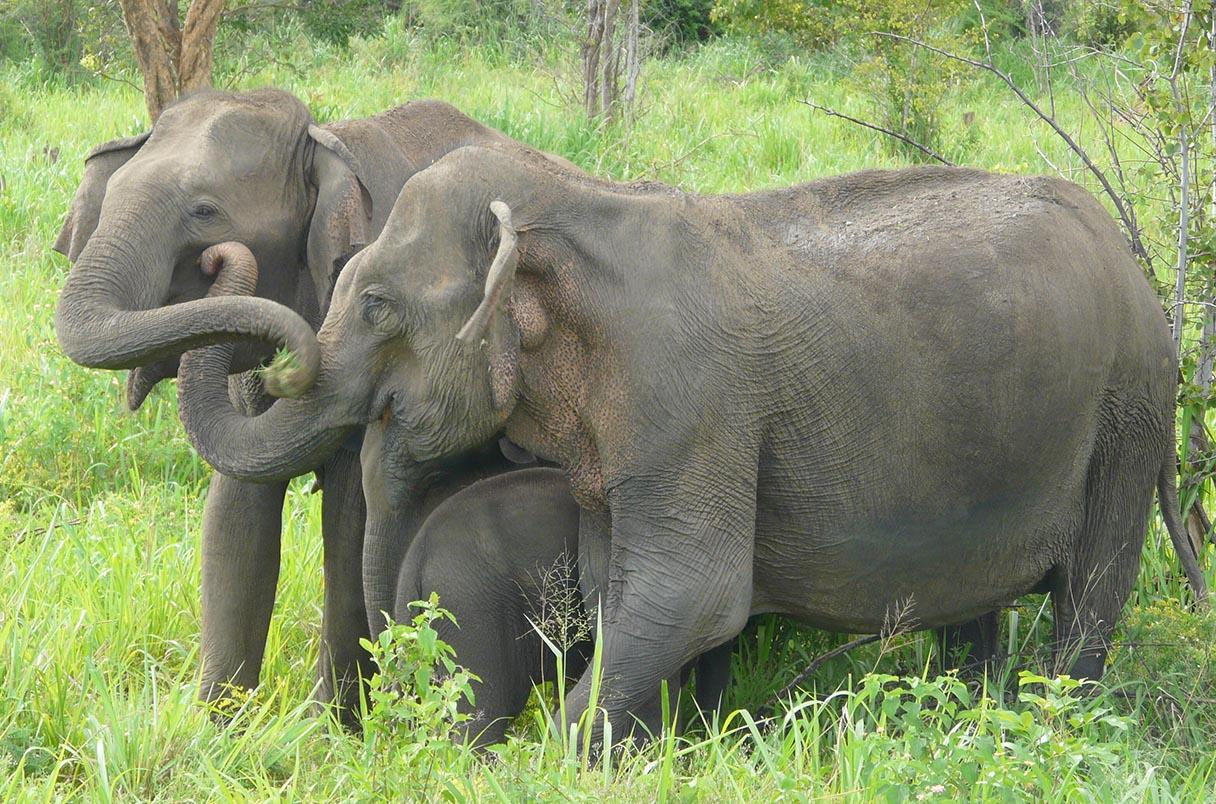
The tragic death of a young elephant named Jasmine still haunts Shermin de Silva. “She had a gentle disposition,” says de Silva, a conservation scientist at the University of California San Diego who studies the social relationships of Asian elephants in a national park in Sri Lanka.
The young animal was particularly fond of another elephant named Janet. After Janet died, probably of old age, Jasmine didn’t form strong bonds with others in her small group. Instead, she began to spend time by herself outside the park. Eventually, she was found shot to death. “That really broke my heart,” de Silva says.
The risk of isolation for that population of elephants appears to be rising. A new study by de Silva and her colleagues, published today in Science, describes a social breakdown among Asian elephants as food has become less plentiful. Unlike elephants in Africa, those in the Sri Lankan park have not responded to stress by forming larger groups. Instead, when the population began to shrink because of food scarcity, the elephants suddenly fractured into smaller groups. “That is a pretty dramatic finding,” says Lucy Bates, a behavioral ecologist at the University of Portsmouth who was not involved in the new study. “We may not yet know the long-term consequences of these changes to social structure, but it’s a worrying picture.”
Elephants’ complex societies and relationships have been well-studied in Africa. There, family groups are known to split up to find food and later merge into larger clans. They are often led by the oldest female, and when poachers kill a group’s matriarch for her tusks, the group can recover thanks to strong relationships between aunts and grandmothers.
When picking a topic for her Ph.D., de Silva was surprised by how little was known about the behavior of Asian elephants (Elephas maximus). While growing up in Sri Lanka, she never saw elephants in the wild; her family wasn’t outdoorsy, and many parks were off-limits because of the civil war fought in the country from 1983 to 2009. But she was nonetheless drawn to the large animals. “I was shocked at how little we knew about their social lives,” she says.
So, in 2006, she began to study a population in Sri Lanka’s Udawalawe National Park, working with staff to identify individual elephants by the distinctive shapes and marks on each elephant’s ears. The crew noted which elephants were hanging out together, a sign they were socially bonded.
Teaming up in 2020, de Silva and Anastasia Madsen, a behavioral ecologist now at the University of Cincinnati, looked at the social bonds of 443 female elephants and how groups had changed over a dozen years of monitoring. At the beginning of the study, they found, there were 20 groups of elephants consisting, on average, of 14 individuals. That began to change 6 years later, when the park’s elephant count started to plummet. By the end of the study, 69% of the elephants present in 2007 had either died or left, and few elephants were moving in from the surrounding area or surviving to adulthood.
The result of this decline was unexpected: The park’s elephants began to split up into more numerous but smaller groups. By 2018, there were 37 groups, an 85% increase from 2007, and the average group size had fallen to 3.5. “The biggest surprise was this fracturing in the social communities,” says Madsen, who led the analysis. As older elephants died, Jasmine and others did not compensate by forming new ties. Instead, weak relationships disappeared, with individuals sticking to only the elephants they knew best.
The elephant deaths and social breakdown occurred as environmental conditions in the park deteriorated. One major problem involves a rise in unpalatable invasive shrubs, which have replaced the grasses that elephants like to eat. New elephants aren’t immigrating into the park, and the remaining elephants are facing increasing competition for limited food. This competition could explain why elephants are becoming more isolated. In addition, less food could mean less energy for socializing.
The loss of social connections could be problematic for the population, Bates says. Being in social groups helps females share knowledge about where to find food or safe areas, and it makes caring for young easier by allowing calves to learn from their elders and one another. “The implications for cultural transmission of knowledge are a big concern. This could have knock-on effects for the survival chances of the remaining elephants.”
George Wittemyer, a wildlife ecologist at Colorado State University who studies African elephants, worries the chronic stress of food scarcity at Udawalawe may be hard to overcome. “The longer it goes on, the deeper the effects are on the social life of the species,” he says.
For Sydney Hope and Joshua Plotnik, comparative psychologists at Hunter College, one of the study’s most concerning findings is that the social breakdown showed up years after the population decline began. If elephant deaths aren’t noticed in other areas, then future problems could start brewing. “This suggests that conservation action must begin long before negative consequences become apparent,” the two write in a commentary on the new study also published in Science. Perhaps future conservation measures will provide the help that Jasmine lacked. “I still think about her,” de Silva says.
Texto de Science tal como lo publicó, leído de su página y mostrado aquí con el formato de El Autómata. El original, en science.org · Volver a la noticia de El Autómata