Ant colonies defy aging patterns as death risk falls and reproduction rises · Phys.org · El Autómata
Lunes, 16 de noviembre de 2026
Portada de las 21:20
Todos los periódicos y la radio, en unoEscrito por IA a partir de 26 medios · Cómo se hace
Biología y genética
Phys.org · texto original · Plants & Animals
Ant colonies defy aging patterns as death risk falls and reproduction rises
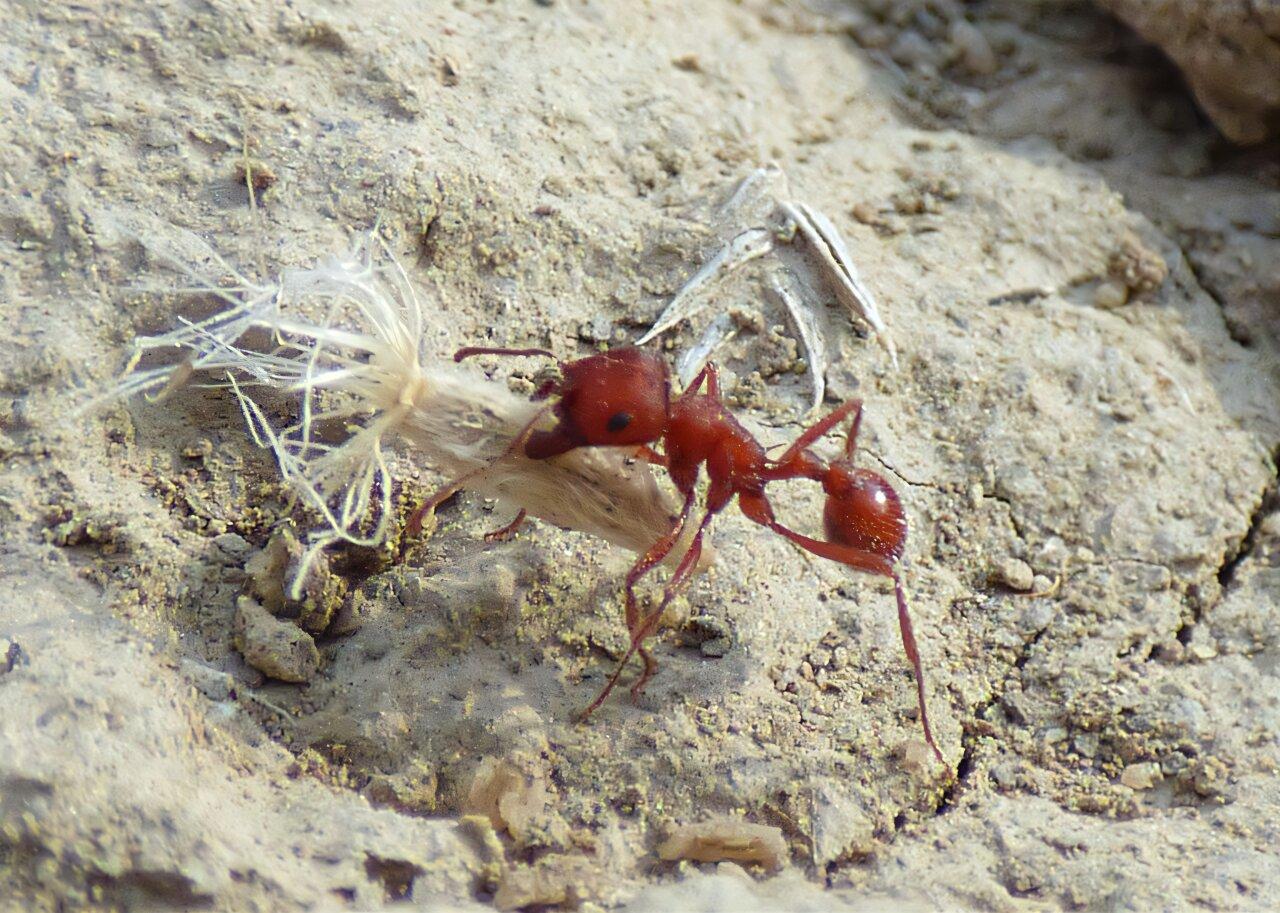
Getting older usually brings a higher risk of death and declining reproduction. Yet for western harvester ant colonies, the opposite occurs. As a colony gets older, it becomes less likely to die and more likely to reproduce.
That surprising finding comes from UH biologists Blaine Cole and Diane Wiernasz of the Department of Biology and Biochemistry. Their study, published in the Proceedings of the National Academy of Sciences, documents a phenomenon called negative senescence and explores how life in a highly organized colony can shape aging.
"Life is always showing us different solutions to similar problems," Cole said.
A discovery three decades in the making
Beginning in 1992, Cole and Wiernasz monitored harvester ants in Mesa County, Colorado. For this study, they analyzed 34 years of observations from 3,285 colonies of known ages, tracking which survived, grew and reproduced.
Fifty-one colonies established before the project began were still alive in 2024. The researchers estimated their ages at approximately 40–42 years.
Initially, the goal was more basic: to understand how ant colonies grow, reproduce and die. It was only after about a decade that their unusual longevity began to emerge.
"There was not a moment of epiphany that ants showed negative senescence, but more of a dawning realization of just how unusual their pattern of aging was," Cole said.
Credit: University of Houston
A colony that keeps renewing itself
What's behind this pattern? An ant colony functions as a superorganism: a group that operates in some ways like a single living organism. One queen produces offspring while workers gather food, care for young and maintain the nest.
Although the queen can live for decades, individual workers live about a year. As they die, new workers replace them, keeping the colony's working "body" renewed even as the colony gets older.
Cole and Wiernasz have called this a replaceable soma—the soma being the nonreproductive part of an organism.
"The 'age' of the soma remains the same whether the colony is 2 years old or 40," Cole explained.
The colony also grows over time. Larger colonies were less likely to die and more likely to reproduce, and the researchers found no evidence that colony growth came at the expense of reproduction.
Importantly, this does not mean individual ants become biologically younger. The findings describe aging at the colony level, where the social organization itself helps sustain survival and reproduction.
Credit: University of Houston
Rethinking the biology of aging
Negative senescence is not unique to ants. Certain plants, fish and sea urchins also show improved survival or reproduction with age. What makes this finding distinctive is the explanation for how a highly social insect colony can follow a similar pattern—by growing and continually replacing its workers.
The research helps scientists understand why aging evolves differently across living systems. It also demonstrates the importance of long-term observation: Patterns that might be missed over a few years can become clear across decades.
Cole hopes to investigate whether other highly social insects, including leaf-cutter ants and termites, follow similar patterns. For him, the larger lesson is about the value of persistence in fundamental research.
"If you study something long enough and pay attention closely enough, you will inevitably discover new and amazing things," he said.
Publication details
Blaine J. Cole et al., A replaceable soma enables negative senescence in harvester ants, Proceedings of the National Academy of Sciences (2026). DOI: 10.1073/pnas.2612817123
Swati Mestri holds a bachelor's degree in Electronics Engineering and has worked as a content editor since 2019. She has experience editing research documents across technology, health care, and materials science, and has a particular interest in technology and space.
Full profile →
Bachelor's in mathematical biology, Master's in creative writing. Well-traveled with unique perspectives on science and language.
Full profile →
Citation:
Ant colonies defy aging patterns as death risk falls and reproduction rises (2026, November 12)
retrieved 16 November 2026
from https://phys.org/news/2026-11-ant-colonies-defy-aging-patterns.html
This document is subject to copyright. Apart from any fair dealing for the purpose of private study or research, no
part may be reproduced without the written permission. The content is provided for information purposes only.