Urban expansion causes ecological collapse in streams in the São Paulo Metropolitan Area · Phys.org · El Autómata
Lunes, 16 de noviembre de 2026
Portada de las 21:20
Todos los periódicos y la radio, en unoEscrito por IA a partir de 26 medios · Cómo se hace
Biología y genética
Phys.org · texto original · Ecology
Urban expansion causes ecological collapse in streams in the São Paulo Metropolitan Area
The advance of urbanization in the São Paulo Metropolitan Area in Brazil is causing the collapse of food webs in local streams. A study published in August in the journal Nature Cities reveals that the impact of the metropolis goes far beyond a simple reduction in species. Degradation selectively eliminates organisms based on their size and simplifies ecological interactions. Networks of 190 connections plummet to just three.
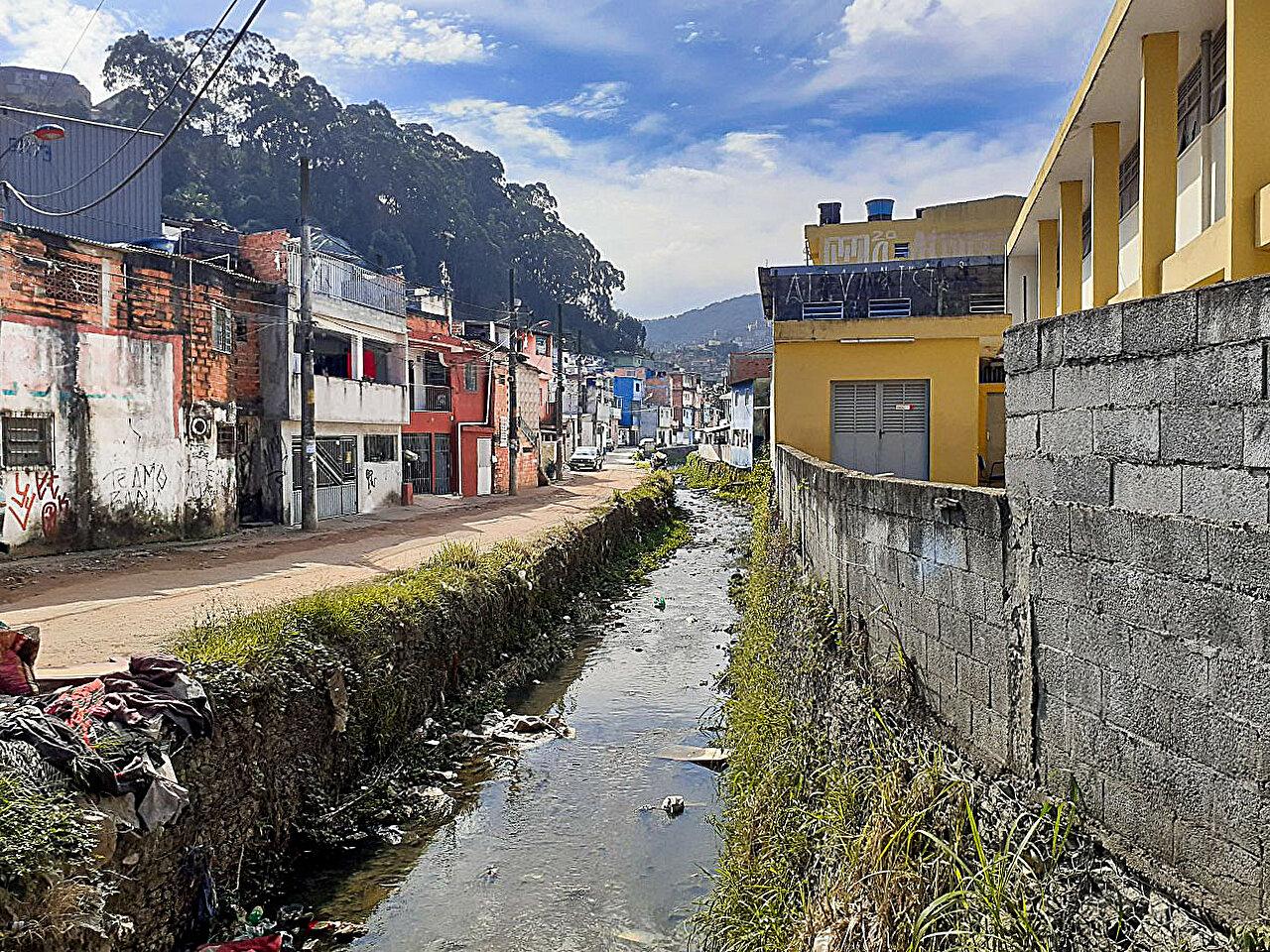
A section of a stream in a micro-watershed in the São Paulo Metropolitan Area. Credit: Luis Schiesari/CBioClima
With the flow of energy in these ecosystems reduced by more than a thousandfold, the streams lose their ability to perform critical environmental services, such as breaking down and neutralizing toxic pollutants. This directly affects the quality of the water that supplies the region's more than 22 million residents.
Victor Saito, a professor in the Department of Environmental Sciences at the Federal University of São Carlos (UFSCar), and Luis Schiesari, a professor of environmental management at the University of São Paulo (USP), led the research. Both are affiliated with the Center for Research on Biodiversity Dynamics and Climate Change (CBioClima), a Research, Innovation, and Dissemination Center (RIDC).
The study focused on analyzing the size structure of organisms that make up stream communities. The findings showed that the loss of biodiversity was not random; urban environments favored only small organisms, eliminating the very small, medium-sized and large ones. Since body size determines an animal's required resources and its predators and prey, this selective extinction disrupts the entire ecosystem.
To conduct the analysis, the researchers carried out comparative sampling in headwater streams—the small waterways that feed into larger rivers—distributed across micro-watersheds in the Upper Tietê region. Thirty micro-watersheds were selected to represent all stages of urbanization, from areas entirely covered by Atlantic Forest to areas entirely urbanized.
The researchers collected fish and invertebrates to reconstruct the food webs at each site, taking into account the body sizes and feeding preferences of the sampled animals. Based on this reconstruction, they estimated the energy flowing through the ecosystem using the predation relationships between predators and their prey.
"What we observed was the near-complete loss of biodiversity and the collapse of stream ecosystems even in the earliest stages of human occupation of the microbasin. The complexity of the food webs plummeted from 190 estimated interactions in fully forested microbasins to just three in fully urbanized areas," says Schiesari. According to the researcher, this collapse is evident even in microbasins with only 12.5% urban coverage and significant forest cover, meaning degradation occurs right from the earliest stages of urbanization rather than gradually.
This simplification has consequences for ecosystem functioning since food webs represent pathways through which energy and carbon flow between organisms. Complex food webs slow the flow of matter in streams, promoting slow processing, which leads to the breakdown of toxic pollutants.
"In streams with simple food webs, matter flows faster and is deposited, after incomplete processing, in the lowest points of the terrain. But it's in those low-lying areas that the reservoirs used for public supply are located, such as the Billings Reservoir, which receives water from several microbasins sampled in the study," the researchers emphasize.
"We can imagine a food web as a mesh: the more threads and connections it has, the more complex the possibilities of energy transfer. Urbanization removes these threads until only a small, simplified and potentially fragile network remains," Saito explained in an interview with the UFSCar news portal.
With fewer connections, less energy circulates. The researchers estimated a 1,446-fold reduction in energy flow among communities in streams most affected by urbanization compared to those in forested areas. The results indicate that urbanization does not merely mean a reduction in species; it can profoundly alter the way the ecosystem functions.
"Each stream within a watershed contributes to the formation of major rivers and reservoirs that supply public water systems. When a stream stops processing organic matter and pollutants, those substances flow freely into larger systems, damaging the public use we depend on," Saito emphasized.
How to reverse the trend
The study is an important step forward because it analyzes urbanization from a perspective that goes beyond simply counting species. By investigating biodiversity, organism size, food web structure, and energy and carbon flux simultaneously, the researchers demonstrated that stream transformation occurs at different levels of ecological organization.
The results serve as a warning about the importance of considering streams as complete ecosystems, not merely as waterways embedded in urban areas. In the researchers' assessment, preserving streams in good environmental condition should be a priority. For degraded streams, it is necessary to invest in wastewater treatment, improve water quality and restore vegetation along the banks, among other measures.
According to Saito, restoration must reestablish ecological processes. "Restoring a stream doesn't just mean improving its appearance or the quality of the water. It means restoring the conditions necessary for its biodiversity, ecological interactions and energy flows to function again."
In addition to UFSCar and USP, the study involved collaboration with scientists from São Paulo State University (UNESP), the State University of Campinas (UNICAMP), the Federal University of ABC (UFABC) and the University of Canterbury in New Zealand.
Publication details
Victor S. Saito et al., Urban expansion and the collapse of tropical stream ecosystems, Nature Cities (2026). DOI: 10.1038/s44284-026-00495-z
Master's in physics with research experience. Long-time science news enthusiast. Plays key role in Science X's editorial success.
Full profile →
Citation:
Urban expansion causes ecological collapse in streams in the São Paulo Metropolitan Area (2026, November 14)
retrieved 16 November 2026
from https://phys.org/news/2026-11-urban-expansion-ecological-collapse-streams.html
This document is subject to copyright. Apart from any fair dealing for the purpose of private study or research, no
part may be reproduced without the written permission. The content is provided for information purposes only.