Chimpanzees blowing raspberries offer first evidence of learned vocal conventions in great ape communication · Phys.org · El Autómata
Lunes, 16 de noviembre de 2026
Portada de las 21:20
Todos los periódicos y la radio, en unoEscrito por IA a partir de 26 medios · Cómo se hace
Biología y genética
Phys.org · texto original · Plants & Animals
Chimpanzees blowing raspberries offer first evidence of learned vocal conventions in great ape communication
Chimpanzees may learn how to use some of their calls from the adults around them, in a surprising parallel with how human children learn words, finds a study from the CNRS Institute of Cognitive Sciences, University of Warwick and Taï Chimpanzee Project.
Foto: vía Phys.org
University of Warwick · Phys.orgPublicado 9 nov, 21:00Ver en phys.org
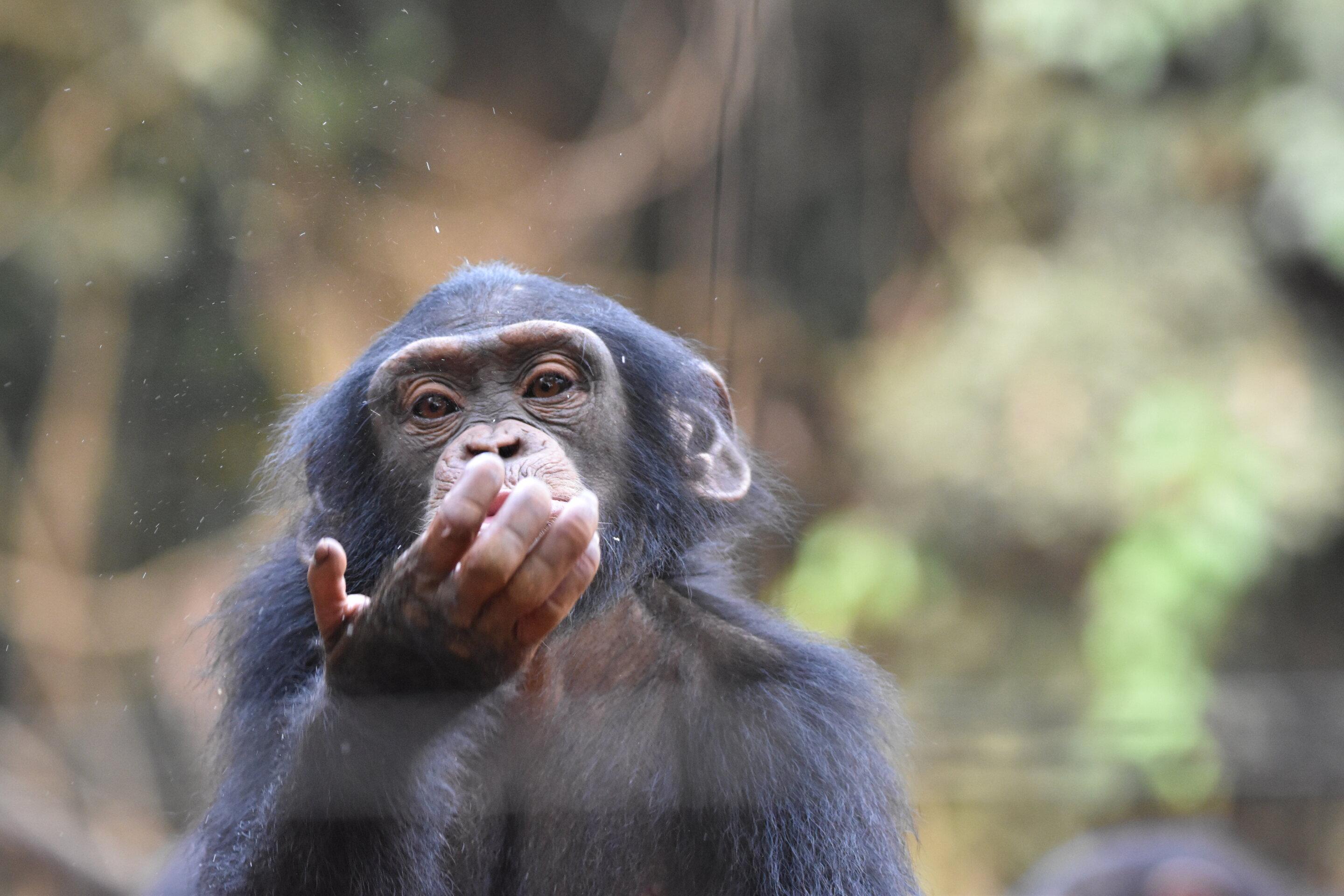
Chimpanzee emitting a raspberry call. These calls show highly flexible usage in communities without role models but stable, settled usage in communities with role models, showing the formation of a signal convention. Credit: Antoine Valet/Tacugama Chimpanzee Sanctuary.
We learn what words mean from the people around us, and different communities use different sounds for the same thing. English speakers say "dog" and French speakers say "chien," and these sounds would work just as well if they were suddenly swapped. Until now, scientists have assumed chimpanzee calls are not like this but are largely instinctive and fixed by biology. The new study tests this for the first time.
One call, different social uses
The study, published in PNAS, focuses on the raspberry: an unvoiced sound made by chimpanzees, much like a person blowing a raspberry with their lips. The team compared how 91 chimpanzees, aged from birth to 55 years, used the raspberry call.
They studied four communities of wild chimpanzees in Taï National Park, Ivory Coast, and four communities of orphaned, peer-raised chimpanzees at Tacugama Chimpanzee Sanctuary in Sierra Leone.
Wild chimpanzees used the raspberry almost exclusively while grooming others. The juveniles at the sanctuary used it across a much wider range of social situations. If the raspberry was purely an instinctive call, groups would be expected to use it in similar ways wherever they grew up. The differences suggest chimpanzees learn not only to make a call, but when and why to use it.
Richard Moore, a philosopher at the University of Warwick and co-author of the study, said, "In everyday communication, we use the words that we do only because our peers do too. It's communal practice that fixes their meaning, rather than features of the words themselves. The discovery that this is true not just for natural languages but also some chimpanzee calls means there's more continuity between chimpanzees' vocal learning and our own than we previously suspected."
An adult newcomer reshapes group communication
The team then found that when an adult chimpanzee was introduced to one of the sanctuary groups, the group's use of the raspberry gradually became more consistent and began to resemble the newcomer's. This suggests adults act as role models, helping a community settle on shared patterns of communication.
The researchers say it is the first time this kind of learned, agreed use has been shown in chimpanzee calls. The link between the sound and its use appears to be passed on from one chimpanzee to another, not built in at birth.
Unlike humans, chimpanzees struggle to learn entirely new call sounds. But the findings suggest they can learn the functions of calls they already make, offering new insight into how communication develops and is passed between generations.
"Even aspects of chimpanzee vocal communication that seemed fixed and unlearned may be shaped by learning, suggesting that there is still much to discover about their vocal repertoire," said Antoine Valet, first author of the study.
Grooming may help explain shared patterns
Senior author Catherine Crockford, of the CNRS Institute of Cognitive Sciences in Lyon, said, "If the raspberry is learned, why do different populations use it in similar ways?
"One possibility is that, while grooming, as chimpanzees use their lips to extract parasites from another's fur, it may be easier to generate a vocalization that uses similar lip movements, a call that is known to prolong grooming bouts. Communities may have found this useful independently, but that wouldn't change the fact that the call is a convention. We need more research to test it."
Roman Wittig, director of the Taï Chimpanzee Project and a senior author of the study, said, "Preserving wild chimpanzee populations is critical if we want to continue to understand the extent to which chimpanzees learn and perpetuate their vocal communication."
Bachelor's in mathematical biology, Master's in creative writing. Well-traveled with unique perspectives on science and language.
Full profile →
Citation:
Chimpanzees blowing raspberries offer first evidence of learned vocal conventions in great ape communication (2026, November 9)
retrieved 16 November 2026
from https://phys.org/news/2026-11-chimpanzees-raspberries-evidence-vocal-conventions.html
This document is subject to copyright. Apart from any fair dealing for the purpose of private study or research, no
part may be reproduced without the written permission. The content is provided for information purposes only.