Differentiation of stem-like CD4+ T cells modulates early effector responses in colorectal cancer · Science · El Autómata
Martes, 17 de noviembre de 2026
Portada de las 23:15
Todos los periódicos y la radio, en unoEscrito por IA a partir de 26 medios · Cómo se hace
Biología y genética
Science · texto original
Differentiation of stem-like CD4+ T cells modulates early effector responses in colorectal cancer
Strategies to improve cancer immunotherapy have largely focused on the intratumor immunosuppressive microenvironment, whereas approaches to amplify peripheral T cells and promote tumor recruitment have not been thoroughly explored. Using imaging mass ...
Foto: vía Science
Yu Zhang, Hu Nie, Zixuan Dai, Liying Zhao, Yihong Wan, Yi Wang, Yikang Chen, Xinhua Chen, Zhijun Xu, Jixing Zhong, Dechun Cheng, Qiushuang Wu, Cong Ouyang, Peilu Lin, Haijun Deng, Zhen Liu, Guoxin Li, Chengqian Yin, Lei Zhang · SciencePublicado 12 nov, 18:00Ver en science.org
Editor’s summary
Anti–PD-1 immunotherapies benefit certain patients with mismatch repair–deficient or microsatellite unstable colorectal cancer (CRC), yet mismatch repair–proficient tumors typically show poor responses. Zhang et al. report that responsive high-microsatellite instability tumors feature specific spatial niches containing T helper 1 (TH1)–like cells, immunostimulatory macrophages, and CD8⁺ T cells (see the Perspective by Olson). In a CRC model, anti–PD-1 monotherapy initiated a similar intratumoral TH1 trajectory but did not reduce tumor growth. Conversely, combining anti-OX40 with anti–PD-1 significantly expanded peripheral Il7r⁺ early effector CD4⁺ T cells from stem-like precursors. The combination therapy enhanced migration and transition into intratumoral TH1-like cells, boosting local and systemic CD8⁺ effector T cell responses and macrophage remodeling. These insights suggest that targeting peripheral CD4⁺ T cell immunity may enhance cancer immunotherapy. —Priscilla N. Kelly
Structured Abstract
INTRODUCTION
Patients with mismatch repair-deficient (dMMR) or microsatellite instability-high (MSI-H) colorectal cancer (CRC) have a more favorable treatment response to anti–programmed cell death protein 1 (PD-1) immunotherapy than individuals with mismatch repair-proficient (pMMR), microsatellite-stable (MSS) tumors. The clinical divergence is accompanied by substantial differences in the tumor immune microenvironment. Although therapeutic efforts in pMMR CRC have largely focused on modulating immunosuppressive cells or pathways in the tumor microenvironment, the response-associated immune architecture that distinguishes dMMR tumors from pMMR tumors is incompletely understood.
RATIONALE
By directly comparing treatment-naïve dMMR and pMMR CRC and examining dMMR tumors after anti–PD-1 immunotherapy in patients, we investigated the immune architecture associated with anti–PD-1 response and features that could be therapeutically induced in pMMR tumors. We examined the response-associated immune architecture in dMMR CRC patients and analyzed whether therapeutic amplification of peripheral CD4+ T cells and redirection of their differentiation trajectory could recapitulate key features of this architecture and improve immunotherapy responses in pMMR CRC mouse models.
RESULTS
We characterized the spatial immune architecture of CRC patients with MSI-H/dMMR and MSS/pMMR tumors by imaging mass cytometry. MSI-H/dMMR tumors were enriched for T helper 1 (TH1)–like niches, including LAMP3+ dendritic cell immune triads and a specialized cellular neighborhood in which TH1-like cells colocalized with CXCL9+ macrophages adjacent to TCF-1+CD8+ T cells, which was also associated with responses to PD-1 blockade. By contrast, MSS/pMMR tumors were dominated by regulatory T (Treg)–associated suppressive interactions. To trace the peripheral origin of TH1-like cells, we performed single-cell and clonal analyses in MSI-H/dMMR CRC patients receiving anti–PD-1 therapy and identified a stem-like CD4+ T cell subset that differentiated into intratumoral TH1-like cells after therapy. In a pMMR CRC model, a similar trajectory was observed after anti–PD-1 monotherapy, but this trajectory alone failed to control tumor growth. By contrast, combining anti-OX40 agonist with PD-1 blockade significantly reduced tumor growth and prolonged survival. Mechanistically, this combination engaged a distinct CD4+ T cell differentiation trajectory in which stem-like CD4+ T cells in tumor-draining lymph nodes (tdLNs) differentiated into peripheral Il7r+ early effector CD4+ T cells with enhanced migratory and intratumoral TH1-like transition potential. The enhanced peripheral CD4+ T cell differentiation was accompanied by the induction of inflammatory Cxcl9+Nos2+ monocyte-macrophage cells and early expansion of CD8+ effector T cells. Multiple in vivo perturbation experiments further demonstrated that the therapeutic benefit of anti-OX40 combined with anti–PD-1 therapy depended on peripheral T cell trafficking from tdLNs and on interferon-γ (IFN-γ)–driven CD8+ effector responses and inflammatory monocyte-macrophage remodeling.
CONCLUSION
We identified a TH1-like CD4+ T cell spatial niche enriched in MSI-H/dMMR CRC patients and linked to anti–PD-1 response and showed that key features of this niche can be recapitulated in pMMR CRC models by combined anti-OX40 and anti–PD-1 therapy. The therapeutic benefit was driven by amplified peripheral CD4+ T cell differentiation, accompanied by coordinated CD8+ effector response and inflammatory myeloid remodeling. Our findings suggest that peripheral CD4+ T cell amplification enhances immunotherapy responses in MSS/pMMR CRC by reshaping the immunosuppressive microenvironment.
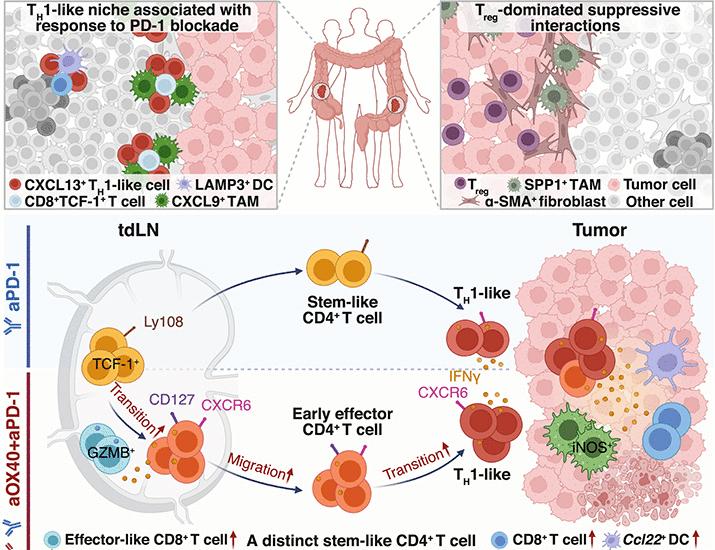
Peripheral CD4+ T cell amplification induces response-associated immune features in colorectal tumors.
(Top) MSI-H/dMMR tumors harbored TH1-like niches associated with PD-1 blockade response, whereas MSS/pMMR tumors showed Treg-dominated interactions. (Bottom) In contrast to PD-1 blockade alone, combined anti-OX40 (aOX40) and anti–PD-1 (aPD-1) therapy preferentially drove tdLN stem-like CD4+ T cells toward peripheral early effector and intratumoral TH1-like states, promoting IFN-γ–driven CD8+ effector responses and inflammatory monocyte-macrophage remodeling. DC, dendritic cell; mono-macs, monocyte-macrophages; TAM, tumor-associated macrophage. [Figure created with BioRender.com]
Abstract
Strategies to improve cancer immunotherapy have largely focused on the intratumor immunosuppressive microenvironment, whereas approaches to amplify peripheral T cells and promote tumor recruitment have not been thoroughly explored. Using imaging mass cytometry in patients with colorectal cancer (CRC), we observed T helper 1 (TH1)–like immune architectures in mismatch repair–deficient tumors associated with response to anti–programmed cell death protein 1 (PD-1) immunotherapy. By contrast, mismatch repair–proficient (pMMR) tumors showed regulatory T–dominant spatial interactions. Clonal analyses revealed that stem-like CD4+ T cells differentiated into TH1-like cells after PD-1 blockade. In pMMR CRC mouse models, combined OX40 agonist and PD-1 blockade suppressed tumor progression by expanding Il7r+ early effector CD4+ intermediates in tumor-draining lymph nodes, promoting migration and connection with TH1-like cells. This was accompanied by interferon-γ–dependent induction of immunostimulatory monocyte-macrophages and CD8+ effector T cells. These findings suggest that leveraging peripheral CD4+ T cell amplification may improve immunotherapy responses.
Access the full article
View all access options to continue reading this article.
Supplementary Materials
The PDF file includes:
Materials and Methods
Figs. S1 to S20
Other Supplementary Material for this manuscript includes the following:
Tables S1 to S13
MDAR Reproducibility Checklist
References and Notes
1
D. T. Le, J. N. Uram, H. Wang, B. R. Bartlett, H. Kemberling, A. D. Eyring, A. D. Skora, B. S. Luber, N. S. Azad, D. Laheru, B. Biedrzycki, R. C. Donehower, A. Zaheer, G. A. Fisher, T. S. Crocenzi, J. J. Lee, S. M. Duffy, R. M. Goldberg, A. de la Chapelle, M. Koshiji, F. Bhaijee, T. Huebner, R. H. Hruban, L. D. Wood, N. Cuka, D. M. Pardoll, N. Papadopoulos, K. W. Kinzler, S. Zhou, T. C. Cornish, J. M. Taube, R. A. Anders, J. R. Eshleman, B. Vogelstein, L. A. Diaz Jr., PD-1 blockade in tumors with mismatch-repair deficiency. N. Engl. J. Med.372, 2509–2520 (2015).
2
K. Ganesh, Z. K. Stadler, A. Cercek, R. B. Mendelsohn, J. Shia, N. H. Segal, L. A. Diaz Jr., Immunotherapy in colorectal cancer: rationale, challenges and potential. Nat. Rev. Gastroenterol. Hepatol.16, 361–375 (2019).
3
C. J. M. Williams, A. M. Peddle, P. M. Kasi, J. F. Seligmann, C. S. Roxburgh, G. W. Middleton, S. Tejpar, Neoadjuvant immunotherapy for dMMR and pMMR colorectal cancers: Therapeutic strategies and putative biomarkers of response. Nat. Rev. Clin. Oncol.21, 839–851 (2024).
4
N. H. Segal, M. Passhak, F. Köse, E. Kubala, E. Elez, H. Kawakami, M. G. Guren, D. J. Jonker, R.-H. Xu, J. Riera, G. Tortora, S. Siena, Y.-M. Yeh, M. M. Yusof, K.-K. Shiu, N. Starling, X. Peng, D. R. Fogelman, D. E. Adelberg, T. W. Kim, Co-formulated favezelimab plus pembrolizumab versus standard-of-care in previously treated, PD-L1-positive metastatic colorectal cancer: the phase 3, randomized KEYFORM-007 study. J. Clin. Oncol.43, LBA248 (2025).
5
I. Mellman, D. S. Chen, T. Powles, S. J. Turley, The cancer-immunity cycle: Indication, genotype, and immunotype. Immunity56, 2188–2205 (2023).
6
J. G. Egen, W. Ouyang, L. C. Wu, Human anti-tumor immunity: Insights from immunotherapy clinical trials. Immunity52, 36–54 (2020).
7
J. R. Giles, A.-M. Globig, S. M. Kaech, E. J. Wherry, CD8+ T cells in the cancer-immunity cycle. Immunity56, 2231–2253 (2023).
8
D. E. Speiser, O. Chijioke, K. Schaeuble, C. Münz, CD4+ T cells in cancer. Nat. Cancer4, 317–329 (2023).
9
D. Y. Oh, S. S. Kwek, S. S. Raju, T. Li, E. McCarthy, E. Chow, D. Aran, A. Ilano, C.-C. S. Pai, C. Rancan, K. Allaire, A. Burra, Y. Sun, M. H. Spitzer, S. Mangul, S. Porten, M. V. Meng, T. W. Friedlander, C. J. Ye, L. Fong, Intratumoral CD4+ T cells mediate anti-tumor cytotoxicity in human bladder cancer. Cell181, 1612–1625.e13 (2020).
10
L. Zhang, X. Yu, L. Zheng, Y. Zhang, Y. Li, Q. Fang, R. Gao, B. Kang, Q. Zhang, J. Y. Huang, H. Konno, X. Guo, Y. Ye, S. Gao, S. Wang, X. Hu, X. Ren, Z. Shen, W. Ouyang, Z. Zhang, Lineage tracking reveals dynamic relationships of T cells in colorectal cancer. Nature564, 268–272 (2018).
11
B. Liu, Y. Zhang, D. Wang, X. Hu, Z. Zhang, Single-cell meta-analyses reveal responses of tumor-reactive CXCL13+ T cells to immune-checkpoint blockade. Nat. Cancer3, 1123–1136 (2022).
12
J. Li, C. Wu, H. Hu, G. Qin, X. Wu, F. Bai, J. Zhang, Y. Cai, Y. Huang, C. Wang, J. Yang, Y. Luan, Z. Jiang, J. Ling, Z. Wu, Y. Chen, Z. Xie, Y. Deng, Remodeling of the immune and stromal cell compartment by PD-1 blockade in mismatch repair-deficient colorectal cancer. Cancer Cell41, 1152–1169.e7 (2023).
13
B. Liu, X. Hu, K. Feng, R. Gao, Z. Xue, S. Zhang, Y. Zhang, E. Corse, Y. Hu, W. Han, Z. Zhang, Temporal single-cell tracing reveals clonal revival and expansion of precursor exhausted T cells during anti-PD-1 therapy in lung cancer. Nat. Cancer3, 108–121 (2022).
14
A. Magen, P. Hamon, N. Fiaschi, B. Y. Soong, M. D. Park, R. Mattiuz, E. Humblin, L. Troncoso, D. D’souza, T. Dawson, J. Kim, S. Hamel, M. Buckup, C. Chang, A. Tabachnikova, H. Schwartz, N. Malissen, Y. Lavin, A. Soares-Schanoski, B. Giotti, S. Hegde, G. Ioannou, E. Gonzalez-Kozlova, C. Hennequin, J. Le Berichel, Z. Zhao, S. C. Ward, I. Fiel, B. Kou, M. Dobosz, L. Li, C. Adler, M. Ni, Y. Wei, W. Wang, G. S. Atwal, K. Kundu, K. J. Cygan, A. M. Tsankov, A. Rahman, C. Price, N. Fernandez, J. He, N. T. Gupta, S. Kim-Schulze, S. Gnjatic, E. Kenigsberg, R. P. Deering, M. Schwartz, T. U. Marron, G. Thurston, A. O. Kamphorst, M. Merad, Intratumoral dendritic cell-CD4+ T helper cell niches enable CD8+ T cell differentiation following PD-1 blockade in hepatocellular carcinoma. Nat. Med.29, 1389–1399 (2023).
15
K. Pelka, M. Hofree, J. H. Chen, S. Sarkizova, J. D. Pirl, V. Jorgji, A. Bejnood, D. Dionne, W. H. Ge, K. H. Xu, S. X. Chao, D. R. Zollinger, D. J. Lieb, J. W. Reeves, C. A. Fuhrman, M. L. Hoang, T. Delorey, L. T. Nguyen, J. Waldman, M. Klapholz, I. Wakiro, O. Cohen, J. Albers, C. S. Smillie, M. S. Cuoco, J. Wu, M. Su, J. Yeung, B. Vijaykumar, A. M. Magnuson, N. Asinovski, T. Moll, M. N. Goder-Reiser, A. S. Applebaum, L. K. Brais, L. K. DelloStritto, S. L. Denning, S. T. Phillips, E. K. Hill, J. K. Meehan, D. T. Frederick, T. Sharova, A. Kanodia, E. Z. Todres, J. Jané Valbuena, M. Biton, B. Izar, C. D. Lambden, T. E. Clancy, R. Bleday, N. Melnitchouk, J. Irani, H. Kunitake, D. L. Berger, A. Srivastava, J. L. Hornick, S. Ogino, A. Rotem, S. Vigneau, B. E. Johnson, R. B. Corcoran, A. H. Sharpe, V. K. Kuchroo, K. Ng, M. Giannakis, L. T. Nieman, G. M. Boland, A. J. Aguirre, A. C. Anderson, O. Rozenblatt-Rosen, A. Regev, N. Hacohen, Spatially organized multicellular immune hubs in human colorectal cancer. Cell184, 4734–4752.e20 (2021).
16
Y. Togashi, K. Shitara, H. Nishikawa, Regulatory T cells in cancer immunosuppression — Implications for anticancer therapy. Nat. Rev. Clin. Oncol.16, 356–371 (2019).
17
X. Guo, H. Nie, W. Zhang, J. Li, J. Ge, B. Xie, W. Hu, Y. Zhu, N. Zhong, X. Zhang, X. Zhao, X. Wang, Q. Sun, K. Wei, X. Chen, L. Ni, T. Zhang, S. Lu, L. Zhang, C. Dong, Contrasting cytotoxic and regulatory T cell responses underlying distinct clinical outcomes to anti-PD-1 plus lenvatinib therapy in cancer. Cancer Cell43, 248–268.e9 (2025).
18
K. E. Yost, H. Y. Chang, A. T. Satpathy, Recruiting T cells in cancer immunotherapy. Science372, 130–131 (2021).
19
M. H. Spitzer, Y. Carmi, N. E. Reticker-Flynn, S. S. Kwek, D. Madhireddy, M. M. Martins, P. F. Gherardini, T. R. Prestwood, J. Chabon, S. C. Bendall, L. Fong, G. P. Nolan, E. G. Engleman, Systemic immunity is required for effective cancer immunotherapy. Cell168, 487–502.e15 (2017).
20
M. F. Fransen, M. Schoonderwoerd, P. Knopf, M. G. M. Camps, L. J. A. C. Hawinkels, M. Kneilling, T. van Hall, F. Ossendorp, Tumor-draining lymph nodes are pivotal in PD-1/PD-L1 checkpoint therapy. JCI Insight3, e124507 (2018).
21
F. Dammeijer, M. van Gulijk, E. E. Mulder, M. Lukkes, L. Klaase, T. van den Bosch, M. van Nimwegen, S. P. Lau, K. Latupeirissa, S. Schetters, Y. van Kooyk, L. Boon, A. Moyaart, Y. M. Mueller, P. D. Katsikis, A. M. Eggermont, H. Vroman, R. Stadhouders, R. W. Hendriks, J. V. D. Thüsen, D. J. Grünhagen, C. Verhoef, T. Van Hall, J. G. Aerts, The PD-1/PD-L1-checkpoint restrains T cell immunity in tumor-draining lymph nodes. Cancer Cell38, 685–700.e8 (2020).
22
Q. Huang, X. Wu, Z. Wang, X. Chen, L. Wang, Y. Lu, D. Xiong, Q. Liu, Y. Tian, H. Lin, J. Guo, S. Wen, W. Dong, X. Yang, Y. Yuan, Z. Yue, S. Lei, Q. Wu, L. Ran, L. Xie, Y. Wang, L. Gao, Q. Tian, X. Zhou, B. Sun, L. Xu, Z. Tang, L. Ye, The primordial differentiation of tumor-specific memory CD8+ T cells as bona fide responders to PD-1/PD-L1 blockade in draining lymph nodes. Cell185, 4049–4066.e25 (2022).
23
K. Nutsch, K. L. Banta, T. D. Wu, C. W. Tran, S. Mittman, E. Duong, B. Y. Nabet, Y. Qu, K. Williams, S. Müller, N. S. Patil, E. Y. Chiang, I. Mellman, TIGIT and PD-L1 co-blockade promotes clonal expansion of multipotent, non-exhausted antitumor T cells by facilitating co-stimulation. Nat. Cancer5, 1834–1851 (2024).
24
S. K. M. Wijesinghe, L. Rausch, S. S. Gabriel, G. Galletti, M. De Luca, L. Qin, L. Wen, C. Tsui, K. Man, L. Heyden, T. Mason, L. D. Newland, A. Kueh, Y. Liao, D. Chisanga, J. Swatler, E. Voulaz, G. Marulli, V. Errico, A. Losurdo, G. R. Rossi, F. Souza-Fonseca-Guimaraes, N. D. Huntington, T. Gebhardt, D. T. Utzschneider, M. J. Herold, W. Shi, J. Schroeder, E. Lugli, A. Kallies, Lymph-node-derived stem-like but not tumor-tissue-resident CD8+ T cells fuel anticancer immunity. Nat. Immunol.26, 1367–1383 (2025).
25
N. Prokhnevska, M. A. Cardenas, R. M. Valanparambil, E. Sobierajska, B. G. Barwick, C. Jansen, A. Reyes Moon, P. Gregorova, L. delBalzo, R. Greenwald, M. A. Bilen, M. Alemozaffar, S. Joshi, C. Cimmino, C. Larsen, V. Master, M. Sanda, H. Kissick, CD8+ T cell activation in cancer comprises an initial activation phase in lymph nodes followed by effector differentiation within the tumor. Immunity56, 107–124.e5 (2023).
26
L. Zhang, Z. Li, K. M. Skrzypczynska, Q. Fang, W. Zhang, S. A. O’Brien, Y. He, L. Wang, Q. Zhang, A. Kim, R. Gao, J. Orf, T. Wang, D. Sawant, J. Kang, D. Bhatt, D. Lu, C. M. Li, A. S. Rapaport, K. Perez, Y. Ye, S. Wang, X. Hu, X. Ren, W. Ouyang, Z. Shen, J. G. Egen, Z. Zhang, X. Yu, Single-cell analyses inform mechanisms of myeloid-targeted therapies in colon cancer. Cell181, 442–459.e29 (2020).
27
G. Espinosa-Carrasco, E. Chiu, A. Scrivo, P. Zumbo, A. Dave, D. Betel, S. W. Kang, H.-J. Jang, M. D. Hellmann, B. M. Burt, H.-S. Lee, A. Schietinger, Intratumoral immune triads are required for immunotherapy-mediated elimination of solid tumors. Cancer Cell42, 1202–1216.e8 (2024).
28
R. Bill, P. Wirapati, M. Messemaker, W. Roh, B. Zitti, F. Duval, M. Kiss, J. C. Park, T. M. Saal, J. Hoelzl, D. Tarussio, F. Benedetti, S. Tissot, L. Kandalaft, M. Varrone, G. Ciriello, T. A. McKee, Y. Monnier, M. Mermod, E. M. Blaum, I. Gushterova, A. L. K. Gonye, N. Hacohen, G. Getz, T. R. Mempel, A. M. Klein, R. Weissleder, W. C. Faquin, P. M. Sadow, D. Lin, S. I. Pai, M. Sade-Feldman, M. J. Pittet, CXCL9:SPP1 macrophage polarity identifies a network of cellular programs that control human cancers. Science381, 515–524 (2023).
29
A. Lyu, Z. Fan, M. Clark, A. Lea, D. Luong, A. Setayesh, A. Starzinski, R. Wolters, M. Arias-Badia, K. Allaire, K. Wu, V. Gurunathan, L. Valderrábano, X. X. Wei, R. A. Miller, E. M. Van Allen, L. Fong, Evolution of myeloid-mediated immunotherapy resistance in prostate cancer. Nature637, 1207–1217 (2025).
30
C. M. Schürch, S. S. Bhate, G. L. Barlow, D. J. Phillips, L. Noti, I. Zlobec, P. Chu, S. Black, J. Demeter, D. R. McIlwain, S. Kinoshita, N. Samusik, Y. Goltsev, G. P. Nolan, Coordinated cellular neighborhoods orchestrate antitumoral immunity at the colorectal cancer invasive front. Cell182, 1341–1359.e19 (2020).
31
J.-L. Teillaud, A. Houel, M. Panouillot, C. Riffard, M.-C. Dieu-Nosjean, Tertiary lymphoid structures in anticancer immunity. Nat. Rev. Cancer24, 629–646 (2024).
32
E. Karimi, M. W. Yu, S. M. Maritan, L. J. M. Perus, M. Rezanejad, M. Sorin, M. Dankner, P. Fallah, S. Doré, D. Zuo, B. Fiset, D. J. Kloosterman, L. Ramsay, Y. Wei, S. Lam, R. Alsajjan, I. R. Watson, G. Roldan Urgoiti, M. Park, D. Brandsma, D. L. Senger, J. A. Chan, L. Akkari, K. Petrecca, M.-C. Guiot, P. M. Siegel, D. F. Quail, L. A. Walsh, Single-cell spatial immune landscapes of primary and metastatic brain tumours. Nature614, 555–563 (2023).
33
Y. Sato, A. Jain, S. Ohtsuki, H. Okuyama, I. Sturmlechner, Y. Takashima, K.-P. C. Le, M. C. Bois, G. J. Berry, K. J. Warrington, J. J. Goronzy, C. M. Weyand, Stem-like CD4+ T cells in perivascular tertiary lymphoid structures sustain autoimmune vasculitis. Sci. Transl. Med.15, eadh0380 (2023).
34
Y. Ma, J. Li, H. Wang, Y. Chiu, C. V. Kingsley, D. Fry, S. N. Delaney, S. C. Wei, J. Zhang, A. Maitra, C. Yee, Combination of PD-1 inhibitor and OX40 agonist induces tumor rejection and immune memory in mouse models of pancreatic cancer. Gastroenterology159, 306–319.e12 (2020).
35
T. C. van der Sluis, G. Beyrend, E. T. I. van der Gracht, T. Abdelaal, S. P. Jochems, R. A. Belderbos, T. H. Wesselink, S. van Duikeren, F. J. van Haften, A. Redeker, L. F. Ouboter, E. Beyranvand Nejad, M. Camps, K. L. M. C. Franken, M. M. Linssen, P. Hohenstein, N. F. C. C. de Miranda, H. Mei, A. D. Bins, J. B. A. G. Haanen, J. G. Aerts, F. Ossendorp, R. Arens, OX40 agonism enhances PD-L1 checkpoint blockade by shifting the cytotoxic T cell differentiation spectrum. Cell Rep. Med.4, 100939 (2023).
36
J. E. Willoughby, L. Dou, S. Bhattacharya, H. Jackson, L. Seestaller-Wehr, D. Kilian, L. Bover, K. S. Voo, K. L. Cox, T. Murray, M. John, H. Shi, P. Bojczuk, J. Jing, H. Niederer, A. J. Shepherd, L. Hook, S. Hopley, T. Inzhelevskaya, C. A. Penfold, C. I. Mockridge, V. English, S. J. Brett, R. Srinivasan, C. Hopson, J. Smothers, A. Hoos, E. Paul, S. L. Martin, P. J. Morley, N. Yanamandra, M. S. Cragg, Impact of isotype on the mechanism of action of agonist anti-OX40 antibodies in cancer: Implications for therapeutic combinations. J. Immunother. Cancer12, e008677 (2024).
37
Y. Bulliard, R. Jolicoeur, J. Zhang, G. Dranoff, N. S. Wilson, J. L. Brogdon, OX40 engagement depletes intratumoral Tregs via activating FcγRs, leading to antitumor efficacy. Immunol. Cell Biol.92, 475–480 (2014).
38
J. C. Castle, M. Loewer, S. Boegel, J. de Graaf, C. Bender, A. D. Tadmor, V. Boisguerin, T. Bukur, P. Sorn, C. Paret, M. Diken, S. Kreiter, Ö. Türeci, U. Sahin, Immunomic, genomic and transcriptomic characterization of CT26 colorectal carcinoma. BMC Genomics15, 190 (2014).
39
G. Germano, S. Lamba, G. Rospo, L. Barault, A. Magrì, F. Maione, M. Russo, G. Crisafulli, A. Bartolini, G. Lerda, G. Siravegna, B. Mussolin, R. Frapolli, M. Montone, F. Morano, F. de Braud, N. Amirouchene-Angelozzi, S. Marsoni, M. D’Incalci, A. Orlandi, E. Giraudo, A. Sartore-Bianchi, S. Siena, F. Pietrantonio, F. Di Nicolantonio, A. Bardelli, Inactivation of DNA repair triggers neoantigen generation and impairs tumour growth. Nature552, 116–120 (2017).
40
M. A. Cardenas, N. Prokhnevska, E. Sobierajska, P. Gregorova, C. B. Medina, R. M. Valanparambil, R. Greenwald, L. DelBalzo, M. A. Bilen, S. Joshi, V. Naryan, V. A. Master, M. G. Sanda, H. T. Kissick, Differentiation fate of a stem-like CD4 T cell controls immunity to cancer. Nature636, 224–232 (2024).
41
Y. Xia, K. Sandor, J. A. Pai, B. Daniel, S. Raju, R. Wu, S. Hsiung, Y. Qi, T. Yangdon, M. Okamoto, C. Chou, K. J. Hiam-Galvez, R. D. Schreiber, K. M. Murphy, A. T. Satpathy, T. Egawa, BCL6-dependent TCF-1+ progenitor cells maintain effector and helper CD4+ T cell responses to persistent antigen. Immunity55, 1200–1215.e6 (2022).
42
D. Bhatt, B. Kang, D. Sawant, L. Zheng, K. Perez, Z. Huang, L. Sekirov, D. Wolak, J. Y. Huang, X. Liu, J. DeVoss, P. S. Manzanillo, N. Pierce, Z. Zhang, A. Symons, W. Ouyang, STARTRAC analyses of scRNAseq data from tumor models reveal T cell dynamics and therapeutic targets. J. Exp. Med.218, e20201329 (2021).
43
M. Andreatta, A. Tjitropranoto, Z. Sherman, M. C. Kelly, T. Ciucci, S. J. Carmona, A CD4+ T cell reference map delineates subtype-specific adaptation during acute and chronic viral infections. eLife11, e76339 (2022).
44
D. Zou, Z. Yin, S. G. Yi, G. Wang, Y. Guo, X. Xiao, S. Li, X. Zhang, N. M. Gonzalez, L. J. Minze, L. Wang, S. T. C. Wong, A. Osama Gaber, R. M. Ghobrial, X. C. Li, W. Chen, CD4+ T cell immunity is dependent on an intrinsic stem-like program. Nat. Immunol.25, 66–76 (2024).
45
J. T. Barata, S. K. Durum, B. Seddon, Flip the coin: IL-7 and IL-7R in health and disease. Nat. Immunol.20, 1584–1593 (2019).
46
D. J. Propper, F. R. Balkwill, Harnessing cytokines and chemokines for cancer therapy. Nat. Rev. Clin. Oncol.19, 237–253 (2022).
47
B. Maier, A. M. Leader, S. T. Chen, N. Tung, C. Chang, J. LeBerichel, A. Chudnovskiy, S. Maskey, L. Walker, J. P. Finnigan, M. E. Kirkling, B. Reizis, S. Ghosh, N. R. D’Amore, N. Bhardwaj, C. V. Rothlin, A. Wolf, R. Flores, T. Marron, A. H. Rahman, E. Kenigsberg, B. D. Brown, M. Merad, A conserved dendritic-cell regulatory program limits antitumour immunity. Nature580, 257–262 (2020).
48
B. Kruse, A. C. Buzzai, N. Shridhar, A. D. Braun, S. Gellert, K. Knauth, J. Pozniak, J. Peters, P. Dittmann, M. Mengoni, T. C. van der Sluis, S. Höhn, A. Antoranz, A. Krone, Y. Fu, D. Yu, M. Essand, R. Geffers, D. Mougiakakos, S. Kahlfuß, H. Kashkar, E. Gaffal, F. M. Bosisio, O. Bechter, F. Rambow, J.-C. Marine, W. Kastenmüller, A. J. Müller, T. Tüting, CD4+ T cell-induced inflammatory cell death controls immune-evasive tumours. Nature618, 1033–1040 (2023).
49
M. Hashimoto, K. Araki, M. A. Cardenas, P. Li, R. R. Jadhav, H. T. Kissick, W. H. Hudson, D. J. McGuire, R. C. Obeng, A. Wieland, J. Lee, D. T. McManus, J. L. Ross, S. J. Im, J. Lee, J. X. Lin, B. Hu, E. E. West, C. D. Scharer, G. J. Freeman, A. H. Sharpe, S. S. Ramalingam, A. Pellerin, V. Teichgräber, W. J. Greenleaf, C. Klein, J. J. Goronzy, P. Umaña, W. J. Leonard, K. A. Smith, R. Ahmed, PD-1 combination therapy with IL-2 modifies CD8+ T cell exhaustion program. Nature610, 173–181 (2022).
50
L. Codarri Deak, V. Nicolini, M. Hashimoto, M. Karagianni, P. C. Schwalie, L. Lauener, E. M. Varypataki, M. Richard, E. Bommer, J. Sam, S. Joller, M. Perro, F. Cremasco, L. Kunz, E. Yanguez, T. Hüsser, R. Schlenker, M. Mariani, V. Tosevski, S. Herter, M. Bacac, I. Waldhauer, S. Colombetti, X. Gueripel, S. Wullschleger, M. Tichet, D. Hanahan, H. T. Kissick, S. Leclair, A. Freimoser-Grundschober, S. Seeber, V. Teichgräber, R. Ahmed, C. Klein, P. Umaña, PD-1-cis IL-2R agonism yields better effectors from stem-like CD8+ T cells. Nature610, 161–172 (2022).
51
K. D. Moynihan, M. P. Kumar, H. Sultan, D. C. Pappas, T. Park, S. M. Chin, P. Bessette, R. Y. Lan, H. C. Nguyen, N. D. Mathewson, I. Ni, W. Chen, Y. Lee, S. Liao-Chan, J. Chen, T. N. M. Schumacher, R. D. Schreiber, Y. A. Yeung, I. M. Djuretic, IL2 targeted to CD8+ T cells promotes robust effector T-cell responses and potent antitumor immunity. Cancer Discov.14, 1206–1225 (2024).
52
C. S. Garris, S. P. Arlauckas, R. H. Kohler, M. P. Trefny, S. Garren, C. Piot, C. Engblom, C. Pfirschke, M. Siwicki, J. Gungabeesoon, G. J. Freeman, S. E. Warren, S. Ong, E. Browning, C. G. Twitty, R. H. Pierce, M. H. Le, A. P. Algazi, A. I. Daud, S. I. Pai, A. Zippelius, R. Weissleder, M. J. Pittet, Successful anti-PD-1 cancer immunotherapy requires T cell-dendritic cell crosstalk involving the cytokines IFN-γ and IL-12. Immunity49, 1148–1161.e7 (2018).
53
X. Guan, R. Hu, Y. Choi, S. Srivats, B. Y. Nabet, J. Silva, L. McGinnis, R. Hendricks, K. Nutsch, K. L. Banta, E. Duong, A. Dunkle, P. S. Chang, C.-J. Han, S. Mittman, N. Molden, P. Daggumati, W. Connolly, M. Johnson, D. R. Abreu, B. C. Cho, A. Italiano, I. Gil-Bazo, E. Felip, I. Mellman, S. Mariathasan, D. S. Shames, R. Meng, E. Y. Chiang, R. J. Johnston, N. S. Patil, Anti-TIGIT antibody improves PD-L1 blockade through myeloid and Treg cells. Nature627, 646–655 (2024).
54
D. Hirschhorn, S. Budhu, L. Kraehenbuehl, M. Gigoux, D. Schröder, A. Chow, J. M. Ricca, B. Gasmi, O. De Henau, L. M. B. Mangarin, Y. Li, L. Hamadene, A. L. Flamar, H. Choi, C. A. Cortez, C. Liu, A. Holland, S. Schad, I. Schulze, A. Betof Warner, T. J. Hollmann, A. Arora, K. S. Panageas, G. A. Rizzuto, R. Duhen, A. D. Weinberg, C. N. Spencer, D. Ng, X. Y. He, J. Albrengues, D. Redmond, M. Egeblad, J. D. Wolchok, T. Merghoub, T cell immunotherapies engage neutrophils to eliminate tumor antigen escape variants. Cell186, 1432–1447.e17 (2023).
55
J. Gungabeesoon, N. A. Gort-Freitas, M. Kiss, E. Bolli, M. Messemaker, M. Siwicki, M. Hicham, R. Bill, P. Koch, C. Cianciaruso, F. Duval, C. Pfirschke, M. Mazzola, S. Peters, K. Homicsko, C. Garris, R. Weissleder, A. M. Klein, M. J. Pittet, A neutrophil response linked to tumor control in immunotherapy. Cell186, 1448–1464.e20 (2023).
56
M. S. F. Ng, I. Kwok, L. Tan, C. Shi, D. Cerezo-Wallis, Y. Tan, K. Leong, G. F. Calvo, K. Yang, Y. Zhang, J. Jin, K. H. Liong, D. Wu, R. He, D. Liu, Y. C. Teh, C. Bleriot, N. Caronni, Z. Liu, K. Duan, V. Narang, I. Ballesteros, F. Moalli, M. Li, J. Chen, Y. Liu, L. Liu, J. Qi, Y. Liu, L. Jiang, B. Shen, H. Cheng, T. Cheng, V. Angeli, A. Sharma, Y.-H. Loh, H. L. Tey, S. Z. Chong, M. Iannacone, R. Ostuni, A. Hidalgo, F. Ginhoux, L. G. Ng, Deterministic reprogramming of neutrophils within tumors. Science383, eadf6493 (2024).
57
A. Elewaut, G. Estivill, F. Bayerl, L. Castillon, M. Novatchkova, E. Pottendorfer, L. Hoffmann-Haas, M. Schönlein, T. V. Nguyen, M. Lauss, F. Andreatta, M. Vulin, I. Krecioch, J. Bayerl, A. M. Pedde, N. Fabre, F. Holstein, S. M. Cronin, S. Rieser, D. D. Laniti, D. Barras, G. Coukos, C. Quek, X. Bai, M. Muñoz i Ordoño, T. Wiesner, J. Zuber, G. Jönsson, J. P. Böttcher, S. Vanharanta, A. C. Obenauf, Cancer cells impair monocyte-mediated T cell stimulation to evade immunity. Nature637, 716–725 (2025).
58
M. Ng, D. Cerezo-Wallis, L. G. Ng, A. Hidalgo, Adaptations of neutrophils in cancer. Immunity58, 40–58 (2025).
59
J. Desai, D. Davar, S. Deva, B. Gao, T. Liu, M. Matos, T. Meniawy, K. J. O’Byrne, M. Sun, M. Voskoboynik, K. Yang, X. Yu, X. Chen, Y. Dong, H. Giovinazzo, S. Leaw, D. Patel, T. Rahman, Y. Wu, D. Day, A phase 1 study of the OX40 agonist, BGB-A445, with or without tislelizumab, an anti-PD-1 monoclonal antibody, in patients with advanced solid tumors. J. Clin. Oncol.41, 2574 (2023).
60
A. Patnaik, J. Call, W. B. McKean, D. W. Rasco, P. J. Oppelt, V. N. Kapoor, V. Kumar, N. Rajasekaran, H. Tang, V. L. Reichert, R. Masia, J. Clement, D. Adkins, Preliminary results of a phase 1, first-in-human, dose escalation study of the anti-CCR8 cytolytic antibody, CHS-114 (formerly SRF114) in patients with advanced solid tumors. J. Clin. Oncol.42, 2664 (2024).
61
J. Gong, C. Liu, J. Yao, J. Xue, J. Dai, Y. Ji, B. Markman, A. Hiong, X. Yang, R. Zhao, Y. Zheng, Q. Li, J. Wu, M. A. Barve, M. H. Ariyapperuma, G. E. Richardson, X. Qin, C. Y. Qin, L. Shen, Efficacy and safety of LM-108, an anti-CCR8 monoclonal antibody, in combination with an anti-PD-1 antibody in patients with gastric cancer: results from phase 1/2 studies. J. Clin. Oncol.42, 2504 (2024).
62
D. K.-C. Chiu, X. Zhang, B. Y.-L. Cheng, Q. Liu, K. Hayashi, B. Yu, R. Lee, C. Zhang, X. An, J. Rajadas, N. E. Reticker-Flynn, E. B. Rankin, E. G. Engleman, Tumor-derived erythropoietin acts as an immunosuppressive switch in cancer immunity. Science388, eadr3026 (2025).
63
E. A. Eisenhauer, P. Therasse, J. Bogaerts, L. H. Schwartz, D. Sargent, R. Ford, J. Dancey, S. Arbuck, S. Gwyther, M. Mooney, L. Rubinstein, L. Shankar, L. Dodd, R. Kaplan, D. Lacombe, J. Verweij, New response evaluation criteria in solid tumours: Revised RECIST guideline (version 1.1). Eur. J. Cancer45, 228–247 (2009).
64
X. Q. Wang, E. Danenberg, C. S. Huang, D. Egle, M. Callari, B. Bermejo, M. Dugo, C. Zamagni, M. Thill, A. Anton, S. Zambelli, S. Russo, E. M. Ciruelos, R. Greil, B. Győrffy, V. Semiglazov, M. Colleoni, C. M. Kelly, G. Mariani, L. Del Mastro, O. Biasi, R. S. Seitz, P. Valagussa, G. Viale, L. Gianni, G. Bianchini, H. R. Ali, Spatial predictors of immunotherapy response in triple-negative breast cancer. Nature621, 868–876 (2023).
65
J.-R. Lin, S. Wang, S. Coy, Y.-A. Chen, C. Yapp, M. Tyler, M. K. Nariya, C. N. Heiser, K. S. Lau, S. Santagata, P. K. Sorger, Multiplexed 3D atlas of state transitions and immune interaction in colorectal cancer. Cell186, 363–381.e19 (2023).
66
U. Schmidt, M. Weigert, C. Broaddus, G. Myers, “Cell detection with star-convex polygons” in Medical Image Computing and Computer Assisted Intervention – MICCAI 2018, A. F. Frangi, J. A. Schnabel, C. Davatzikos, C. Alberola López, G. Fichtinger, Eds. (Springer, 2018), pp. 265–273.
67
J. Windhager, V. R. T. Zanotelli, D. Schulz, L. Meyer, M. Daniel, B. Bodenmiller, N. Eling, An end-to-end workflow for multiplexed image processing and analysis. Nat. Protoc.18, 3565–3613 (2023).
68
J. H. Levine, E. F. Simonds, S. C. Bendall, K. L. Davis, E. D. Amir, M. D. Tadmor, O. Litvin, H. G. Fienberg, A. Jager, E. R. Zunder, R. Finck, A. L. Gedman, I. Radtke, J. R. Downing, D. Pe’er, G. P. Nolan, Data-driven phenotypic dissection of AML reveals progenitor-like cells that correlate with prognosis. Cell162, 184–197 (2015).
69
M. Ukita, J. Hamanishi, H. Yoshitomi, K. Yamanoi, S. Takamatsu, A. Ueda, H. Suzuki, Y. Hosoe, Y. Furutake, M. Taki, K. Abiko, K. Yamaguchi, H. Nakai, T. Baba, N. Matsumura, A. Yoshizawa, H. Ueno, M. Mandai, CXCL13-producing CD4+ T cells accumulate in the early phase of tertiary lymphoid structures in ovarian cancer. JCI Insight7, e157215 (2022).
70
S. J. Fleming, M. D. Chaffin, A. Arduini, A.-D. Akkad, E. Banks, J. C. Marioni, A. A. Philippakis, P. T. Ellinor, M. Babadi, Unsupervised removal of systematic background noise from droplet-based single-cell experiments using CellBender. Nat. Methods20, 1323–1335 (2023).
71
S. Yang, S. E. Corbett, Y. Koga, Z. Wang, W. E. Johnson, M. Yajima, J. D. Campbell, Decontamination of ambient RNA in single-cell RNA-seq with DecontX. Genome Biol.21, 57 (2020).
72
S. L. Wolock, R. Lopez, A. M. Klein, Scrublet: Computational identification of cell doublets in single-cell transcriptomic data. Cell Syst.8, 281–291.e9 (2019).
73
F. A. Wolf, P. Angerer, F. J. Theis, SCANPY: Large-scale single-cell gene expression data analysis. Genome Biol.19, 15 (2018).
74
C. Domínguez Conde, C. Xu, L. B. Jarvis, D. B. Rainbow, S. B. Wells, T. Gomes, S. K. Howlett, O. Suchanek, K. Polanski, H. W. King, L. Mamanova, N. Huang, P. A. Szabo, L. Richardson, L. Bolt, E. S. Fasouli, K. T. Mahbubani, M. Prete, L. Tuck, N. Richoz, Z. K. Tuong, L. Campos, H. S. Mousa, E. J. Needham, S. Pritchard, T. Li, R. Elmentaite, J. Park, E. Rahmani, D. Chen, D. K. Menon, O. A. Bayraktar, L. K. James, K. B. Meyer, N. Yosef, M. R. Clatworthy, P. A. Sims, D. L. Farber, K. Saeb-Parsy, J. L. Jones, S. A. Teichmann, Cross-tissue immune cell analysis reveals tissue-specific features in humans. Science376, eabl5197 (2022).
75
M. Dai, X. Pei, X. J. Wang, Accurate and fast cell marker gene identification with COSG. Brief. Bioinform.23, bbab579 (2022).
76
Y. Hao, S. Hao, E. Andersen-Nissen, W. M. Mauck III, S. Zheng, A. Butler, M. J. Lee, A. J. Wilk, C. Darby, M. Zager, P. Hoffman, M. Stoeckius, E. Papalexi, E. P. Mimitou, J. Jain, A. Srivastava, T. Stuart, L. M. Fleming, B. Yeung, A. J. Rogers, J. M. McElrath, C. A. Blish, R. Gottardo, P. Smibert, R. Satija, Integrated analysis of multimodal single-cell data. Cell184, 3573–3587.e29 (2021).
77
G. La Manno, R. Soldatov, A. Zeisel, E. Braun, H. Hochgerner, V. Petukhov, K. Lidschreiber, M. E. Kastriti, P. Lönnerberg, A. Furlan, J. Fan, L. E. Borm, Z. Liu, D. van Bruggen, J. Guo, X. He, R. Barker, E. Sundström, G. Castelo-Branco, P. Cramer, I. Adameyko, S. Linnarsson, P. V. Kharchenko, RNA velocity of single cells. Nature560, 494–498 (2018).
78
V. Bergen, M. Lange, S. Peidli, F. A. Wolf, F. J. Theis, Generalizing RNA velocity to transient cell states through dynamical modeling. Nat. Biotechnol.38, 1408–1414 (2020).
79
S. Jin, M. V. Plikus, Q. Nie, CellChat for systematic analysis of cell-cell communication from single-cell transcriptomics. Nat. Protoc.20, 180–219 (2025).
80
R. Browaeys, W. Saelens, Y. Saeys, NicheNet: Modeling intercellular communication by linking ligands to target genes. Nat. Methods17, 159–162 (2020).
81
C. Xu, M. Prete, S. Webb, L. Jardine, B. J. Stewart, R. Hoo, P. He, K. B. Meyer, S. A. Teichmann, Automatic cell-type harmonization and integration across human cell atlas datasets. Cell186, 5876–5891.e20 (2023).