A Massive Cell Atlas Offers an Unprecedented Window into the Mammalian Brain
Researchers from the BRAIN Initiative map primate basal ganglia, uncovering novel cell types and disease mechanisms across species.
Researchers from the BRAIN Initiative map primate basal ganglia, uncovering novel cell types and disease mechanisms across species.
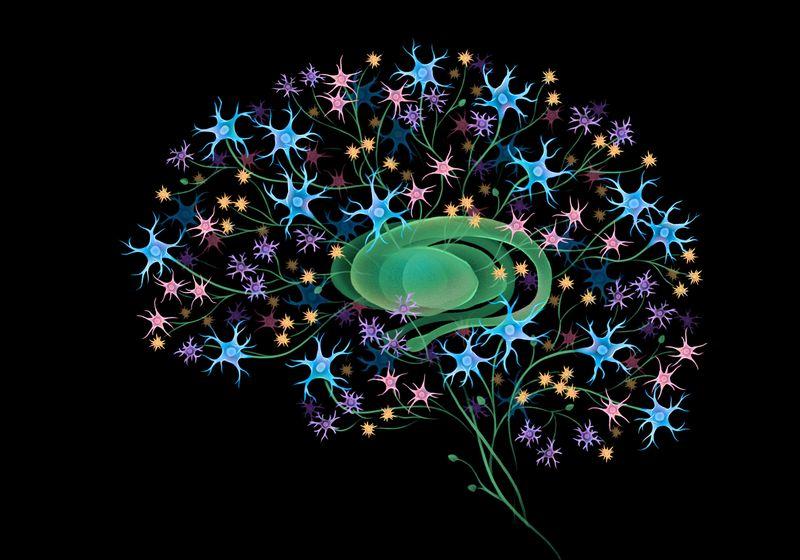
The mammalian brain is a bustling hub of intricate webs of billions of neurons connected by a network of neural highways with signals racing along winding routes. Researchers have sought to understand the nitty gritty details of this complex organ for a while.
With this target, scientists from a number of institutes launched the BRAIN Initiative Cell Atlas Network (BICAN) a few years ago. “The main goal of this was to leverage single cell genomics technologies to profile millions of cells in the mammalian brain,” said Hongkui Zeng, an investigator at the Allen Institute.
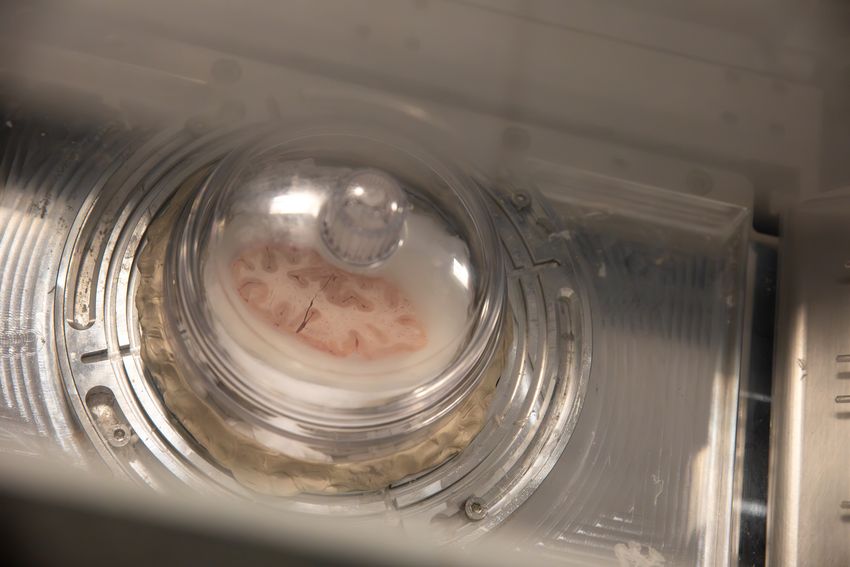
For building the atlas, the researchers relied on human brain tissue that was donated postmortem to support neuroscience research.
Allen Institute/ Jenny Burns
Now, in a step toward that direction, Zeng and hundreds of other researchers from dozens of institutes across nine countries joined forces to unveil a multi-species cellular atlas of the basal ganglia: structures at the base of the forebrain. The findings, which were published today in a package of 26 studies in Cell Press journals, represent the most detailed library of basal ganglia to date, offering a resource to better understand brain cell characteristics and how diseases affect these.
“This is going to be a major landmark reference atlas,” said Zeng. “It's like the Human Genome Project…[we] set up a blueprint, a reference for the community to use.”
Continue reading below...
Latest science news stories
Topic-tailored resources and events
Customized newsletter content
SubscribeAs part of the BICAN project, researchers hoped to map the whole brain, but this was not possible at once. “So, we decided to focus on the basal ganglia as a good starting point,” said Ed Lein, a researcher at the Allen Institute who was involved in the project.
The basal ganglia are a cluster of cell bodies that integrate signals from different brain regions like the cortex, thalamus, and brainstem to shape habit formation, movement, decision making, and more. Dysfunction of these circuits is linked with neurodegenerative disorders, like Parkinson’s disease and Huntington’s disease, and psychiatric conditions, like obsessive-compulsive disorder and schizophrenia.
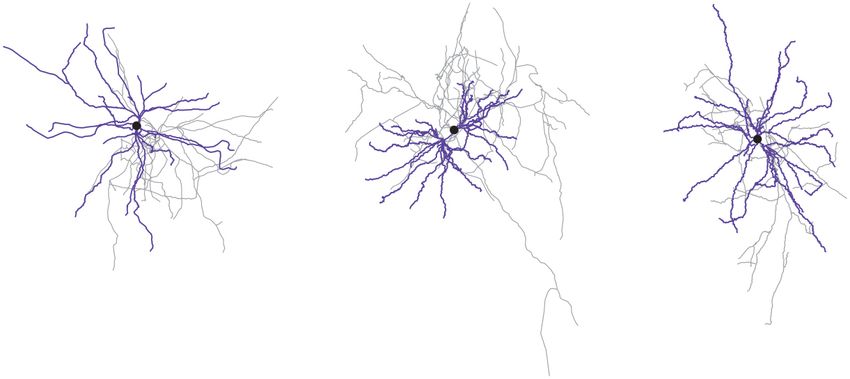
The atlas helped uncover a previously unrecognized type of spiny projection neuron (SPN), a specialized type of neuron that expresses a serotonin receptor, which was associated with elevated schizophrenia risk.
Allen Institute/ Xiao-Ping Liu and Brian Kalmbach
To map this disease-relevant region of the brain, the researchers turned to samples from marmosets, macaques, and postmortem human tissue. While researchers have previously created mouse brain atlases, doing so using human samples was not straightforward.
“This is one thing to do in a mouse brain. A mouse brain is…small,” said Lein. “It’s another [thing] to do in a human brain.”
However, through coordination between cross-disciplinary teams, the researchers developed a standardized framework for mapping both the neuroanatomy and molecular and sequencing data. The researchers subjected brain samples to single-nucleus transcriptomic techniques. They analyzed the expression of genes by profiling more than 20 million cells from humans, three million cells from macaques, and 1.5 million cells from marmosets.
They complemented this approach by incorporating epigenomic, spatial genomic, and multiomic datasets from these samples, which helped them map the cellular diversity and spatial organization of this region and compare these across species. “Integrating large amounts of data across species is a major computational challenge that we overcame,” remarked Zeng.
And the researchers’ efforts paid off. Across the 26 studies, scientists uncovered crucial insights into the basal ganglia.
The international teams’ findings will help to understand the development of neurological conditions and diseases.
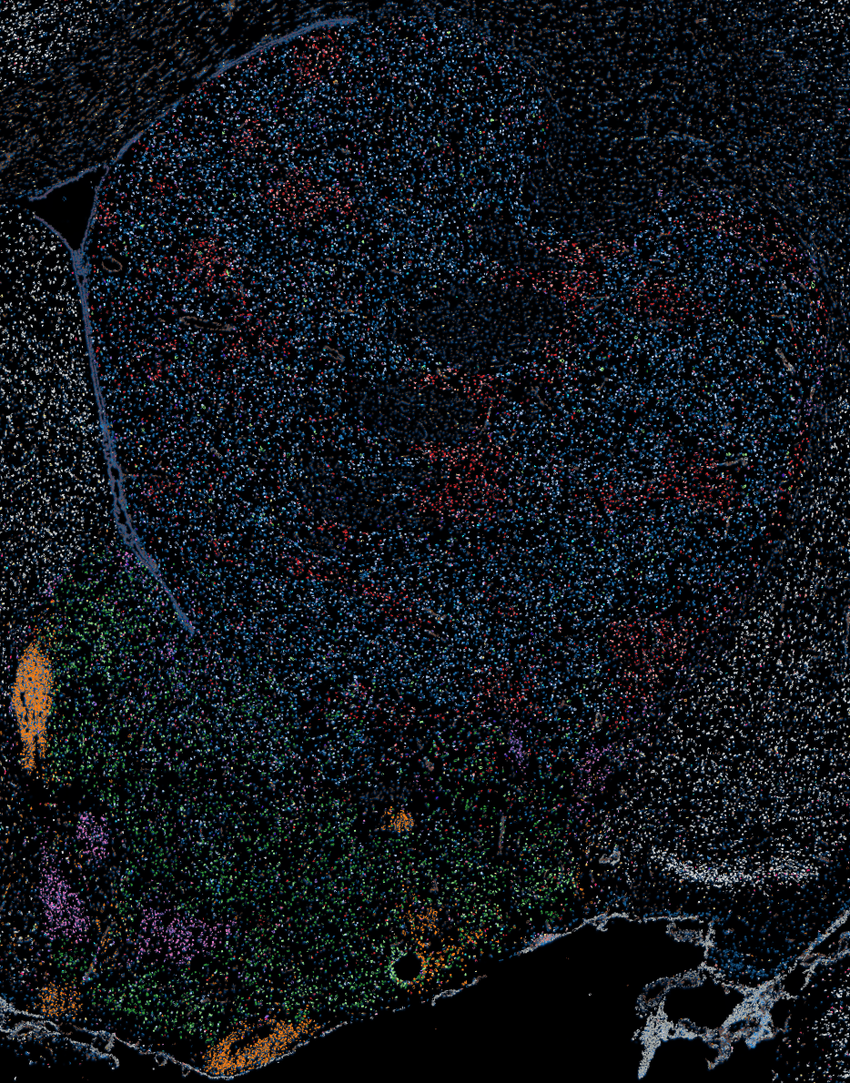
Section of the marmoset brain from a spatial transcriptomic experiment showed basal ganglia transcriptomic cell types of the striatum in their anatomical locations.
Allen Institute/ Meghan Turner and Madeleine Hewitt
For instance, one group discovered a new type of brain cell linked with schizophrenia and bipolar disorder. Another team found genetic changes in certain basal ganglia cells associated with autism, which could offer a deeper understanding of this condition. “Those examples just show the utility of the atlas in revealing the underlying molecular changes for diseases,” said Zeng.
The atlas also sheds light on cellular characteristics in healthy brains. “We've been studying the cortex for a long time where we have gone [into] extremely great detail, and it just continues to astonish me how great the cellular diversity is,” noted Lein.
The researchers also said that the atlas offered deeper insight into similarities and differences across species. Cells are organized within domains in the brain regions, and this organization is largely conserved across mammalian species, Lein explained.
Zeng agreed, adding that peeking into the basal ganglia at such a high resolution across species could help scientists better understand the evolution of brains. “We can begin to understand in detail the conservation versus divergence, exactly how that's happening in specific cell types,” she said. “[We] can really do [an] apples-to-apples comparison.”
While the atlas grants an unprecedented view into the mammalian basal ganglia, more work needs to be done, said both Zeng and Lein. Specifically, the researchers are now working on extending this information to the whole brain. “The goal is eventually—and [by] eventually, I mean only a couple years from now—we’ll have the entire brain covered,” said Lein.
“There are still many more regions that need to be profiled,” agreed Zeng. “This study really sets the foundation for us to do that.”
Both Zeng and Lein noted that the enormous collaborative effort from dozens of research groups allowed them to reach this stage. “Bringing together dozens of labs, hundreds of researchers with a common goal…it’s been extremely effective,” said Lein. “This is really a success of consortium style science.”
Zeng agreed, “I'm very excited [that] the community really worked together, painstakingly setting up this kind of a common pipeline and standardized the process and that now can be used again and again and also can be expanded.”
Texto de The Scientist tal como lo publicó, leído de su página y mostrado aquí con el formato de El Autómata. El original, en the-scientist.com · Volver a la noticia de El Autómata